
How to Stop Trying to Control Everything: 5 Powerful Ways
I have learnt that learning to stop trying to control everything is not always about wanting power over people or situations. Sometimes, you are simply afraid of losing something you have invested deeply in, and that fear can quietly make you keep trying… fixing, improving, giving more, and hoping that one more effort might change the outcome.
I know this because I have lived through it. There was a time when I could see the red flags, and somewhere deep inside, I knew things were not healthy… and if they are unhealthy, then they are unhealthy. Yet I couldn’t bring myself to step away. I kept thinking that perhaps something could still change. Perhaps if I tried differently, gave more, understood more, or did something I hadn’t done before, things might finally work out.
That is where the need for control can become exhausting, and you might struggle with uncertainty.
You may know that you cannot control another person, yet still find yourself trying to control the direction in which the situation is moving. You keep pouring in because letting go feels like accepting a loss. You keep looking at occasional positive moments and using them to keep your hope alive, even when the larger pattern is telling you something else.
For a long time, I didn’t understand that I wasn’t really trying to control another person. I was trying to control the outcome because I was afraid of losing it. I wanted a safety net. I wanted certainty. And I desperately wanted things to work out.
Eventually, I understood something that changed the way I look at control. Sometimes you have already done your part, and what you need is the courage to stop pouring in and begin letting go of control.
For me, that courage came slowly, with Holy Mother’s Kripa. And that experience taught me that surrender doesn’t mean doing nothing. It means doing what is yours to do, and learning to leave what isn’t yours at the feet of the Divine.
If you are striving to stop trying to control everything… perhaps the first step is not to control yourself better, but to understand what you are actually attempting to hold on to. In this article, I’ll share what I learned about control, fear, surrender, and letting go.
Why Do I Feel the Need to Control Everything?
I used to think that when I was trying so hard to make things work, I was simply doing my part. I was putting in effort, trying different things, giving more, and hoping that something would change. But when I look back now, I can see that something deeper was happening. I was finding it very difficult to release the outcome.
Sometimes, your need for control comes from a very simple place: you desperately want something to work out. You have invested your time, emotions, energy or hope into it, and the thought of losing it feels like another failure you don’t want to add to your life. That can make you keep pouring in, even when you already know, somewhere inside, that you have done enough.
That was happening with me. I knew things were unhealthy. I could see the red flags. Yet I kept hoping that perhaps one more effort would change things. I would notice an occasional positive moment and hold on to it, while quietly pushing the larger pattern to the side. Looking back, I can see that I was not really looking at the situation as it was. I was looking at what I desperately wanted it to become.
And this is where trying to control everything can become complicated. You may not be trying to control another person at all. You may already know that you cannot control another person’s choices, values, behaviour, or decisions. But you can still try to control the outcome by changing your own behaviour endlessly… by giving more, explaining more, planning more, adjusting more, or trying harder.
I learnt this the hard way.
A relationship involves two people. You can make an effort, communicate, support the other person, and genuinely try to make things work. But you cannot force another person to move in the direction you want.
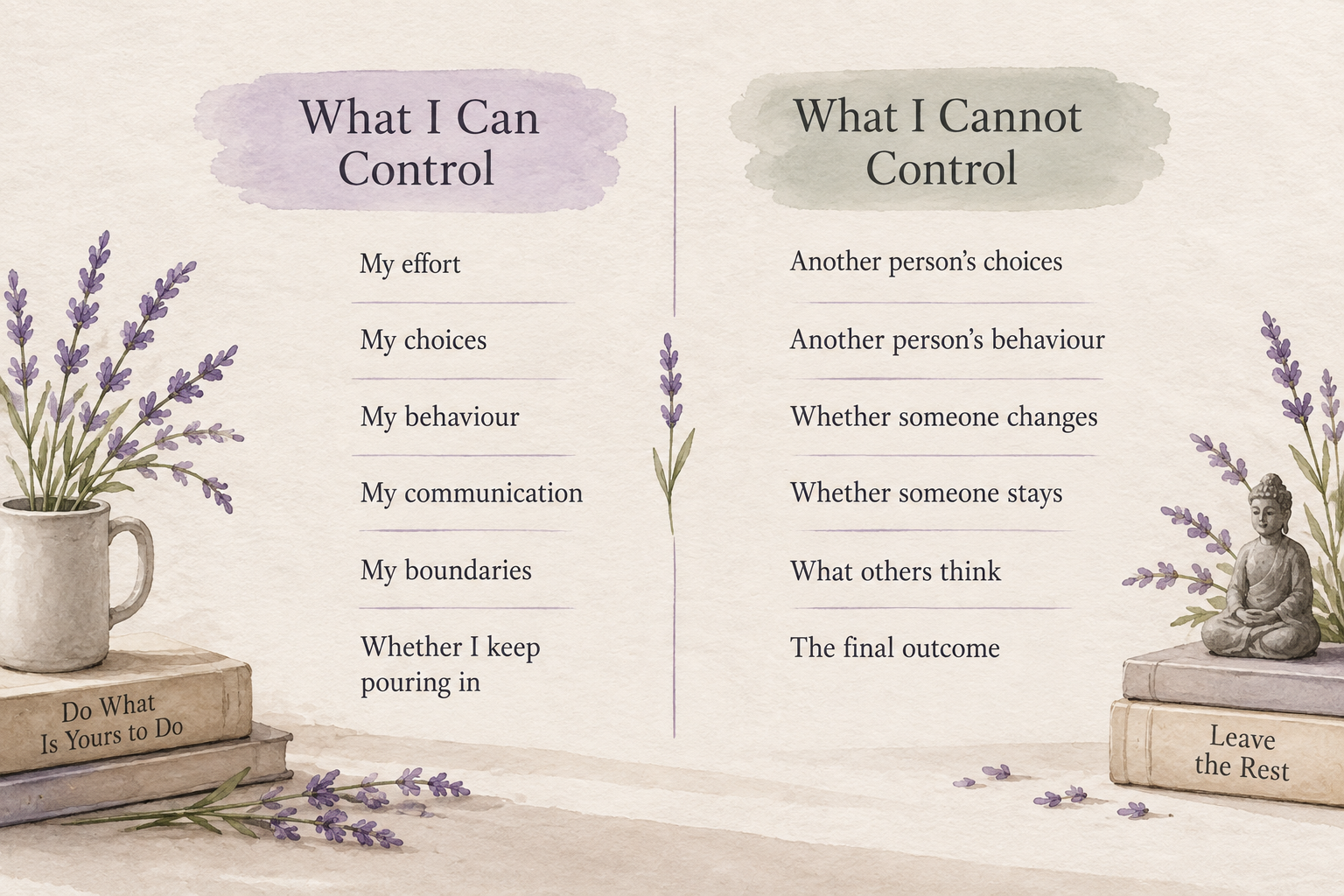
Two people have their own upbringing, values, beliefs, choices, and ways of looking at life. Sometimes things simply don’t click in the way you hoped they would. And no amount of effort from one person can manufacture that connection.
I think the same principle applies beyond relationships. If you start a business, you can control the effort you put into finding customers. You can improve your product, offer discounts, change your approach, and keep working. But you cannot control whether every person will buy from you. You can influence many things, but you cannot guarantee the outcome.
I eventually realised that I was trying to guarantee something that was never completely mine to guarantee.
There was fear underneath it too. I was afraid of losing the person, but I was also afraid of what that loss would mean. I didn’t want another failed relationship or friendship added to my tally. Somewhere subconsciously, perhaps I was thinking that if I could just make this work, I wouldn’t have to face another failure. So I kept trying.
But sometimes trying harder is not wisdom.
Sometimes the letting go of control has to begin with an uncomfortable question: Have I actually done my part, or am I continuing because I’m afraid of what will happen if I stop?
For me, the answer eventually became clear. I had already done my part. In fact, I had done more than what could reasonably be expected from one person. I should probably have stopped much earlier, but I couldn’t. I had become attached to the hope of a different outcome.
There is another thing I learnt about myself. Something can become a toxic comfort zone. You may know that it is unhealthy and still find it difficult to leave because your mind has become accustomed to it. Familiarity can feel strangely safer than the unknown, even when that familiarity is hurting you.
That is why I don’t think we should simply tell someone, “Just let go.” Sometimes you don’t yet have the inner strength to do that.
For me, that strength came through Holy Mother’s Kripa. My dependence on the Divine slowly grew, and as that dependence grew, I found it easier to leave some things unresolved. I could finally say, I have tried. I have done what I could. Now let me leave this at Mother’s feet and see what happens.
I could not manufacture that surrender by force. I had to pray for it.
And perhaps that is one of the deeper reasons we try to control everything. We want the safety of knowing that if we keep holding on, we can prevent the painful outcome. But sometimes life asks us to loosen our grip… not because we should stop caring, but because we need to recognise where our responsibility ends.
How to Stop Trying to Control Everything
If you want to stop trying to control everything, I don’t think the answer is to suddenly become detached or stop caring. I tried to find that balance myself, and I learnt that you need to become very honest about what you are actually doing.
Ask yourself: Have I already done my part?
I used to remind myself, “Debanjalee, you have done more than what can actually be done from an individual’s part.”
It helped me see that a relationship, a situation, or even a project cannot be carried by one person’s effort forever.
And trust me, you have to tell yourself this again and again. Your mind will constantly force you to think that maybe we can try this, or that…or maybe if we do this differently this time, things might just click.
If you have already acted sincerely, communicated, tried different approaches, and given what you reasonably could, ask yourself whether doing more will genuinely change something… or whether you are simply afraid to stop.
Sometimes, you need to stop pouring in and allow the situation to reveal what happens without your constant intervention.
Look at the pattern, not the occasional positive moment
This was something I learnt the hard way.
I was ignoring the larger pattern and giving too much importance to occasional positive moments. When something repeatedly shows you the same reality, you cannot keep using one good moment to convince yourself that everything is fine.
So when you feel the need for control, step back and look at the pattern honestly. What has actually been happening over time? Are things becoming healthier, or are you repeatedly trying to rescue the same situation?
Clarity often begins when you stop negotiating with the pattern.
Stop making decisions from fear
Fear can make you keep pouring into something long after you know it has become unhealthy. It can make you think, “Maybe one more effort will change things.” Sometimes, you may even tell yourself that you’re fine while quietly carrying something that is breaking you within.
I eventually had to tell myself: Okay, I will not pour in further. Let me see what happens.
That decision did not come easily. There was hurt underneath it. But it helped me understand that doing more is not always the same as doing the right thing.
Learn to leave some things unresolved
This is difficult when your mind wants an answer, an assurance, or a particular outcome. If something remains unresolved, you may feel anxious and experience an almost irresistible urge to go back and do something again. Sometimes, a simple question can help you pause and understand what is actually happening inside you.
I learnt that I could leave some things unresolved only when my dependence on the Divine began to grow.
For me, this became a prayer to Holy Mother: Mother, I want to increase my dependence on You. I don’t want to suffer like this anymore. Give me the courage to leave some things unresolved.
You can practise mantra japa, meditation, and prayer, but don’t treat them like a five-day formula that will suddenly make you detached. Your relationship with the Divine has to become more intimate slowly. You have to honestly ask for that grace.
When that dependence grows, you don’t need to know exactly how everything will turn out before you step back.
Do your part, then release the outcome
Letting go of control does not mean becoming passive. You still take responsibility. You still act when action is required. But there comes a point when you have to stop trying to manufacture the result.
If something is unhealthy and you have already seen the pattern clearly, pouring in more cannot make it healthy.
I learnt this very firmly: if something can survive only because you are constantly holding it together, it is not really surviving.
At that point, I don’t think the question is, “How can I control this better?” The question becomes, “What is mine to do now?”
And whatever is not mine to do, I can place at Mother’s feet.
That is where controlling behaviour slowly gives way to surrender. Not because you stop caring, but because you finally understand that your job is to do what is yours to do… and trust the Divine with what isn’t.
How to Stop Trying to Control Everything: Final Thoughts
I don’t think you have to control everything to take responsibility for your life.
You can make an effort, show up sincerely, do what is yours to do, and still accept that the final outcome may not be in your hands.
I learnt this slowly.
Sometimes, you have already done your part. Continuing to pour in does not always mean that you are trying harder. Sometimes, it simply means that you are afraid to stop.
And if something can survive only because you are constantly holding it together, it isn’t really surviving.
For me, surrender became the space between doing my part and accepting what I could not change. With Holy Mother’s Kripa, I slowly learnt to place what I could not control at Her feet and ask for the strength to bear whatever came next. And sometimes I didn’t even know what should I pray for… Yet I tried to cling to Her feet as much as possible, and trust Mother.
Surrender does not mean doing nothing. It means doing what is yours to do and trusting the Divine with what isn’t.
Sometimes, letting go of control is not about losing something. It is about finally stopping yourself from losing you.
Jai Maa…🙏





One Comment