How to Do Mantra Japa: Step by Step with 7 Important Rules
How to do Mantra Japa seems like a simple question until you actually sit down to practise.
The first few days of practice often bring more questions than answers. Am I doing this correctly? Is my mind supposed to wander this much? Should I use a japa mala? Does God really hear my prayers even when I struggle to concentrate? If you’ve ever found yourself asking these questions, you’re certainly not alone.
Perhaps you have recently received a Guru Mantra from your Guru, or maybe you simply feel drawn towards mantra chanting and wish to deepen your relationship with God. Whatever has brought you here, it is natural to wonder whether there is a proper way to practise. After all, when something becomes as deeply personal as prayer, you naturally want to approach it with sincerity, reverence and the right understanding.
The beautiful thing about Mantra Japa is that God does not ask for perfection before accepting your prayers. At the same time, our scriptures and realised saints have lovingly shared practical guidelines that can help make your mantra japa practice more focused, disciplined and spiritually enriching. Just as every skill becomes easier with the right foundation, learning how to chant a mantra with the proper attitude can gradually make japa meditation feel more natural and meaningful.
In this article, we’ll explore how to do Mantra Japa step by step, followed by some important Mantra Japa rules based on the practical guidance shared by Swami Sivananda in Japa Yoga.
We’ll also look at a few common mistakes beginners often make so you can begin your practice with greater confidence, sincerity and devotion.
How to Do Mantra Japa: Step by Step
Although the essence of Mantra Japa lies in devotion and sincerity, our scriptures and realised saints have also shared practical guidance that helps us develop a steady practice. The following steps are based on the teachings of Swami Sivananda’s Japa Yoga, presented here in a simple and practical way for beginners who wish to understand how to do Mantra Japa.
Step 1: Prepare Yourself Before You Begin Mantra Japa
Before you sit for mantra chanting, spend a few moments preparing yourself both physically and mentally. If possible, bathe before your practice. If that isn’t practical, washing your hands, feet, and face is also considered helpful. A brief prayer before beginning can gently turn your mind towards God and prepare your heart for japa meditation.
Step 2: Choose a Quiet Place and Sit Comfortably
A calm environment makes it easier to practise Mantra Japa with attention. Sit in a comfortable and steady posture where you can remain relaxed without unnecessary movement. Swami Sivananda also recommends facing the East or North while chanting, as these directions have traditionally been considered favourable for spiritual practice.
Step 3: Begin Your Mantra Japa with Devotion
Once you begin chanting, don’t treat the mantra as words to be repeated mechanically. Repeat it with reverence, faith and devotion. As Swami Sivananda explains in Japa Yoga, the Divine Name is filled with spiritual power, and regular repetition gradually purifies the mind and deepens one’s relationship with God.
Swami Sivananda also describes three ways of practising Mantra Japa: Vaikhari (audible chanting), Upamsu (soft whispering) and Manasika (mental repetition). Beginners often find audible or whispered japa easier because it helps keep the mind focused. As concentration develops, many practitioners gradually move towards mental japa, which is considered the most subtle form of practice.
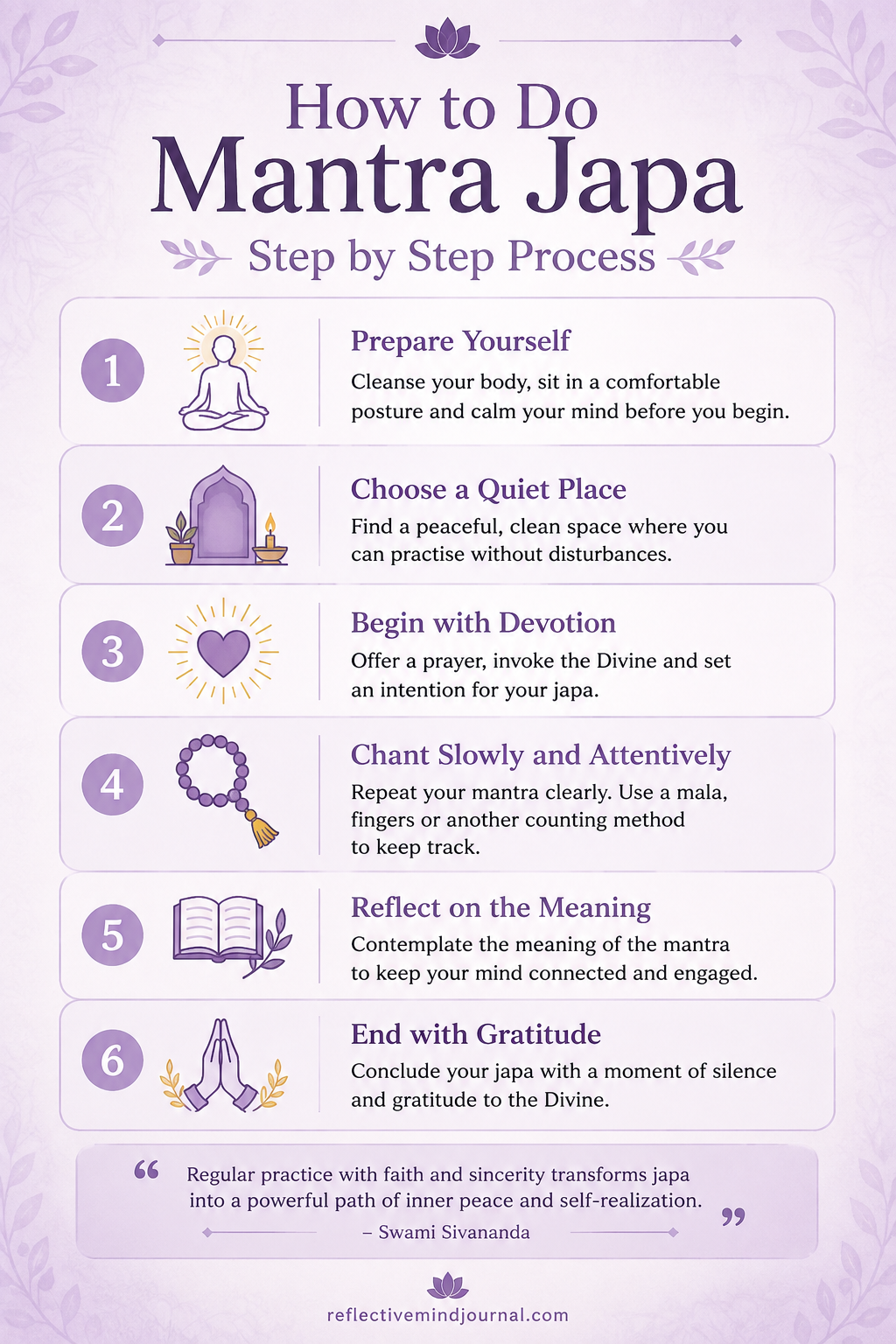
Step 4: Chant Slowly and with Full Attention
One of the most important aspects of how to chant a mantra is maintaining attention. Avoid rushing through the repetitions simply to complete a fixed number. Instead, pronounce the mantra clearly, chant at a comfortable pace, and gently bring your attention back whenever the mind wanders. Consistency matters far more than speed.
Some people find a japa mala helpful because it keeps the mind anchored to the practice.
Swami Sivananda recommends a Rudraksha or Tulasi mala of 108 beads and explains that when you reach the Meru bead, you should turn the mala around rather than crossing it.
If you don’t have a mala for mantra japa, you can also count your japa on your fingers or use another simple counting method with the help of a Japa counter (if allowed as per the tradition you follow) until you develop a steady practice.
Whichever method you follow, let your attention remain on the mantra rather than on the counting itself.
Step 5: Let the Meaning of the Mantra Fill Your Heart
As your mantra japa practice gradually becomes steady, don’t limit yourself to merely repeating the words. Reflect on the presence of your chosen Deity and the meaning of the mantra. This transforms chanting from a routine into a heartfelt spiritual practice, allowing japa meditation to become deeper with time.
Step 6: End Your Practice with Gratitude
Rather than getting up immediately after finishing your chanting, remain seated quietly for a few moments. Offer a silent prayer of gratitude and allow the peace created through Mantra Japa to settle within you before returning to your daily activities.
7 Important Rules of Mantra Japa
Learning how to do Mantra Japa is only one part of the journey. Equally important is understanding the disciplines that help you stay consistent and deepen your practice over time.
The following Mantra Japa rules are inspired by the practical guidance shared by Swami Sivananda in Japa Yoga. Think of them not as rigid restrictions, but as gentle principles that can gradually strengthen your spiritual life.
1. Practise Mantra Japa Every Day
One of the most important Mantra Japa rules is regularity.
Rather than chanting occasionally for long hours, try to make mantra japa practice a part of your daily routine. Even if you begin with a small number of repetitions, consistency will benefit you far more than irregular bursts of enthusiasm.
2. Chant with Faith, Love and Attention
The power of mantra chanting does not lie in repeating words mechanically.
While learning how to chant a mantra, remember to chant with faith, devotion, and awareness. Whenever the mind wanders, gently bring it back to the mantra instead of becoming frustrated.
3. Keep Your Mind Focused on God During Japa Meditation
As you continue your japa meditation, try to remember the presence of your chosen Deity or reflect on the meaning of the mantra.
This helps transform repetition into prayer and gradually deepens your connection with the Divine.
4. Avoid Rushing to Complete Numbers
Completing a certain number of repetitions can help build discipline, but it should never become the only goal. Don’t rush through your Mantra Japa simply to finish a count. Slow, attentive chanting with devotion is far more valuable than hurried repetition.
5. Maintain Reverence for Your Mantra
Treat your mantra with respect and sincerity. Swami Sivananda reminds us that the Divine Name is sacred.
Approach your mantra japa practice with humility rather than treating it as another task to tick off your daily checklist.
6. Be Patient and Trust the Process
Many beginners expect immediate experiences or visible spiritual progress. In reality, Mantra Japa works quietly and gradually.
Continue your practice with patience, even on days when your mind feels restless, and you are not able to stop overthinking. Every sincere repetition has its value.
7. Let Mantra Japa Become a Way of Life
Over time, the goal is not simply to finish your daily rounds but to allow the remembrance of God to become a natural part of your life.
As your mantra japa practice matures, you’ll find that the spirit of the mantra begins to accompany you beyond your dedicated prayer time, gently leading you to completely surrender to God.
Common Mistakes Beginners Make During Mantra Japa
Every spiritual journey has a learning curve, and Mantra Japa is no different. If you’re just beginning, don’t be discouraged if you make a few mistakes along the way. The important thing is to recognise them with humility and gently return to your practice.
Here are some common mistakes you may make during mantra japa if you’re just starting.
Expecting Immediate Spiritual Results
Many beginners start mantra japa practice hoping to experience instant peace, deep concentration, or profound spiritual experiences.
While such moments may come in their own time, Mantra Japa usually works quietly and gradually. Trust the process and continue your practice without measuring your progress every day.
Focusing More on Numbers Than Devotion
Maintaining a daily target can help build discipline, but don’t let numbers become your only goal. It’s easy to feel guilty when you miss your intended count or become anxious about completing a fixed number of repetitions.
While discipline certainly has its place, the heart of mantra chanting is remembering God with sincerity and devotion. Let your numbers support your practice, not replace its purpose.
Comparing Your Journey with Others
Every person’s spiritual journey unfolds differently. Some people may find it easier to concentrate, while others may take longer to develop a steady japa meditation practice.
Avoid comparing your experiences with those of others. Instead, focus on your own relationship with God and continue your practice with faith, patience and perseverance.
If you still struggle with comparison, don’t keep it bottled up. Talk to God honestly, just as Arjuna did in Bhagavad Gita 2.7.
Final Thoughts
Learning how to do Mantra Japa is important, but don’t let the desire to do everything perfectly stop you from simply beginning.
There will be days when your mind is calm and days when it refuses to settle. Both are a part of the journey. On such days, Prayers for overthinking can gently help you return your mind to God.
Approach your mantra japa practice with sincerity, patience, and faith.
Keep showing up, one mantra at a time. Over the years, you may realise that it isn’t just your chanting that has changed. Quietly and gently, the mantra has been changing you too.
Frequently Asked Questions
How to Do Mantra Japa Without a Mala?
If you’re wondering how to do Mantra Japa without a mala, Swami Sivananda explains in Japa Yoga that you can count your repetitions on the fingers of your right hand. Another simple method in mantra japa practice he mentions is keeping track of completed rounds with small stones or by maintaining a fixed practice duration using a watch. Some practitioners also use digital japa counters today. If you wish to use one, it’s always best to follow the guidance of your Guru or the traditions of your lineage.
How to Do Mantra Japa on Your Fingers?
According to Swami Sivananda’s Japa Yoga, how to do Mantra Japa on your fingers is quite straightforward. During mantra chanting, use the fingers of your right hand for counting your japa, while the left thumb is traditionally used to keep track of completed rounds by moving along the finger lines. This allows you to maintain your count even without a mala.
How Many Times Should You Do Mantra Japa Every Day?
There is no single number that applies to everyone. Swami Sivananda recommends maintaining regularity and even suggests a minimum daily practice, but the ideal number may also depend on your Guru’s guidance and your spiritual routine. As you learn how to do Mantra Japa, remember that consistency is usually more valuable than trying to achieve very high numbers occasionally.