
Why Do I Say “I’m Fine” When I’m Not?: A Quiet Reckoning
Why do I say “I’m fine” when I’m not?
I asked myself that question yesterday, although, strangely enough, I wasn’t actually feeling bad when I said it.
Someone I have known for years, though I would not really call him a friend, asked me how I was doing. We have spoken on and off over the years. We chat sometimes. We know each other well enough to ask about each other’s lives, but not well enough for me to tell him everything that is going on inside mine.
So he asked me a very ordinary question.
“How are you?”
And I replied, almost without thinking, “Yes, I’m doing fine.”

That was it.
There was no long pause in which I decided what to hide. There was no moment in which I thought, I must not tell him what I’m going through.
The answer simply came out.
And perhaps that is what made me think about it later.
Because if you looked at my life as a whole at this point, there are quite a few things that aren’t exactly fine.
I’m trying to build a self-employment career. I’m trying to make something meaningful out of my blog and hoping that, with time and Mother’s grace, it succeeds. There are uncertainties about the future. There are a few problematic friendships. There are practical worries. Sometimes a payment or a bill suddenly comes to mind, and I think, Oh God, how am I going to manage this?
There are many things.
But they don’t sit on my chest every minute of every day.
They are more like a quiet hum somewhere at the back of my mind.
Sometimes that hum becomes loud. Sometimes it overwhelms me. Sometimes, by Mother’s grace, it becomes so quiet that I can work, talk, laugh, write, pray, or simply go about my day without feeling weighed down by it.
And yesterday, when that acquaintance asked me how I was, I was actually fine in that moment.
So I said I was fine.
The more I thought about it, the more I realized how strange our little social ritual around these two words can be.
Someone asks, “How are you?”
And we say, “I’m fine.”
“I’m good.”
“Doing well, thanks.”
It is almost automatic.
There is even a linguistic reason this can happen. “How are you?” often functions as part of a conventional greeting rather than as an invitation to give someone a detailed account of everything happening inside your life. “Fine” or “good” becomes a familiar response in that exchange.
And I think there is something comforting about that.
You don’t have to stop and open the doors to your entire private life every time someone asks how you are.
You can simply say, “I’m fine,” and continue with the conversation.
I know this from my own life because there are things I don’t want to explain to people.
Not because I am always hiding.
Not because I am pretending.
And not because I believe that being vulnerable is somehow weak.
Sometimes I simply don’t want a particular conversation to become more personal than it needs to be.
An acquaintance doesn’t necessarily need to know about my worries about my career. He doesn’t need to know about every difficult friendship. He doesn’t need to know which thoughts visit me when I am alone. He doesn’t need the complete story of my life just because he was kind enough to ask how I was.
And that, I have slowly come to understand, is not dishonesty.
It is privacy.
There was a time when I was much more likely to take my problems to people.
I would talk about what was happening. I would look for opinions. I would look for solutions. I would tell people what was troubling me and hope that somehow, through another person’s words, I would know what to do next.
But something has been changing in me over the years.
With Holy Mother’s grace, I have been trying to become less dependent on human beings for the answers to my deepest problems and more dependent on Her.

I am not saying that I have achieved this.
Far from it.
I am not an advanced practitioner. I am not an enlightened or illumined soul. I am a work in progress.
And sometimes this work is difficult.
I can pray to Mother about something and still not receive an answer immediately. I can tell Her exactly what is troubling me and still have to wait. And that waiting can be terribly challenging.
Perhaps part of learning to wait has also been discovering how to stop trying to control everything. I am still practising this because when something matters deeply to me, my mind naturally wants to find a solution, make a plan, or somehow make the uncertainty disappear.
I want the kind of relationship with Her in which I can speak to Her as naturally as I speak to my biological mother and hear Her answer just as naturally.
I am not there yet.
But I am trying.
So when something troubles me now, my first instinct is increasingly to take it to Her.
I can tell Her the things I don’t tell people.
I can tell Her the things I cannot explain properly to anyone else.
I can tell Her about the fears that come and go during the day, the uncertainty about my future, the things I wish were different, the friendships that trouble me, the practical worries that suddenly appear in my mind.
More than once, I have sat with the question of what should I pray for… when my mind is too full to know where to begin
And I don’t have to pretend with Her.
More importantly, I don’t have to pretend with myself.
That distinction matters to me.
I can tell another person, “I’m fine,” without secretly telling myself that everything in my life is fine.
I know the difference.
I know when things are difficult.
I know when I am worried.
I know when I feel alone.
I know when I don’t know how something is going to work out. Not knowing what will happen is something I’ve been learning to sit with, and it has made me think more deeply about why I struggle with uncertainty.
Even on the nights when I don’t have words for any of it, I have slowly been learning how to pray when you’re worried, instead of trying to think my way through everything alone
And I also know that I still have hope.
For me, that hope is connected to Mother.
There are things in my life where I have seen what I understand as Her grace, including things that have happened over many years and things I have seen even in my present life. I don’t claim that I understand Mother’s grace completely. I would never make such a claim.
But to say that I have seen nothing would also be untrue.
So I am learning to wait.
And perhaps that is another reason I don’t feel the need to tell every person what is happening inside me.
I have actually made a conscious spiritual effort to keep some things between Mother and me.
Recently, I even asked one or two people close to me to pray for me. But I couldn’t tell them exactly what I wanted them to pray for.
I simply told them that there were certain things for which I needed their prayers.
Why?
Because I had made a sankalp.
I had promised Mother that I would try not to keep taking those particular things to human beings. I wanted to take them to Her instead. It was, in its own small way, my attempt to learn how to surrender to God completely, even if only in this one corner of my life.
That doesn’t mean I have stopped needing people.
It doesn’t mean I don’t value human affection or companionship.
And it certainly doesn’t mean I have become completely surrendered.
I haven’t.
It is a journey.
But something has changed.
I have become more careful about what I hand over to other people.
Part of that comes from experience.
I have been hurt by people I trusted. I have shared things with people who appeared to care about what I was going through, only to discover later that what I had shared had become something they could laugh about, mock, or discuss behind my back.
After experiencing that enough times, complete trust becomes difficult.
And I don’t think I need to pretend otherwise.
People sometimes talk about vulnerability as though the answer is simply to open your heart completely and tell people exactly what you’re going through.
I don’t believe that anymore.
Not everyone deserves every part of your story.
Not everyone knows how to hold another person’s vulnerability carefully.
And yet, strangely, becoming more private about my own struggles has not made me want to become careless with someone else’s.
If a friend comes to me because they need comfort, help, an opinion, a solution, or simply someone to sit with them emotionally for a while, I still want to be there.
I try to listen without making their pain into a joke.
I try not to take something someone trusted me with and turn it into entertainment later.
Perhaps my own experiences have made me more conscious of how precious another person’s vulnerability actually is.
But I still don’t think I owe everyone the same access to my own vulnerability.
And maybe this is where “I’m fine” becomes more complicated than we usually make it.
Sometimes “I’m fine” is avoidance.
Sometimes it is fear.
Sometimes it is a way of pretending that nothing is wrong when, deep down, we know very well that something is wrong.
But sometimes “I’m fine” is simply what it sounds like.
I’m fine right now.
I’m okay enough to have this conversation.
I don’t want to discuss the rest.
I don’t know you well enough to tell you.
I haven’t decided that I want to share this.
Or simply:
I am having an ordinary moment in the middle of a complicated life.
I sometimes wonder about something else, too.
Perhaps one reason “I’m fine” comes so naturally to us is that somewhere deep inside, we genuinely want to be fine.
We want our lives to be okay.
We want our problems to resolve.
We want the people we love to be safe.
We want our work to succeed.
We want our relationships to make sense.
We want to wake up one morning and feel that everything has finally fallen into place.
Maybe that desire makes the words come easily.
“I’m fine.”
Not because we have solved everything.
Not because our life is perfect.
But because being fine is what we hope to become.
And perhaps there is nothing wrong with that.
What I don’t want to do is use those two words to fool myself.
I don’t want to look at a difficult situation and say, Everything is perfectly fine, when I know it isn’t.
I don’t want to deny what I am carrying.
I want to be able to say to myself, honestly. Yes, this is difficult. Yes, I’m worried. Yes, there are things I don’t know how to solve.
And then, in the same breath, I want to be able to say:
But I am taking these things to Mother.
That is a very different kind of “I’m fine.”
It is not the fine of someone who has solved everything.
It is not the fine of someone who has no worries.
It is not even necessarily the fine of someone who knows what tomorrow will bring.
It is the fine of someone who can be honest about what is difficult without believing that difficulty is the whole story.
Yesterday, I told an acquaintance, “I’m fine.”
And I meant it.
Not because everything in my life is fine.
But because, in that moment, I was.
And because there are some things I would rather take to Mother than explain to another human being.
Perhaps that is what I have finally started to understand about those two ordinary words.
You can say “I’m fine” without denying your pain.
You can protect your privacy without lying to yourself.
You can keep some parts of your story between yourself and God.
And you can still hope that, with grace, the things that aren’t fine today may one day become fine too.
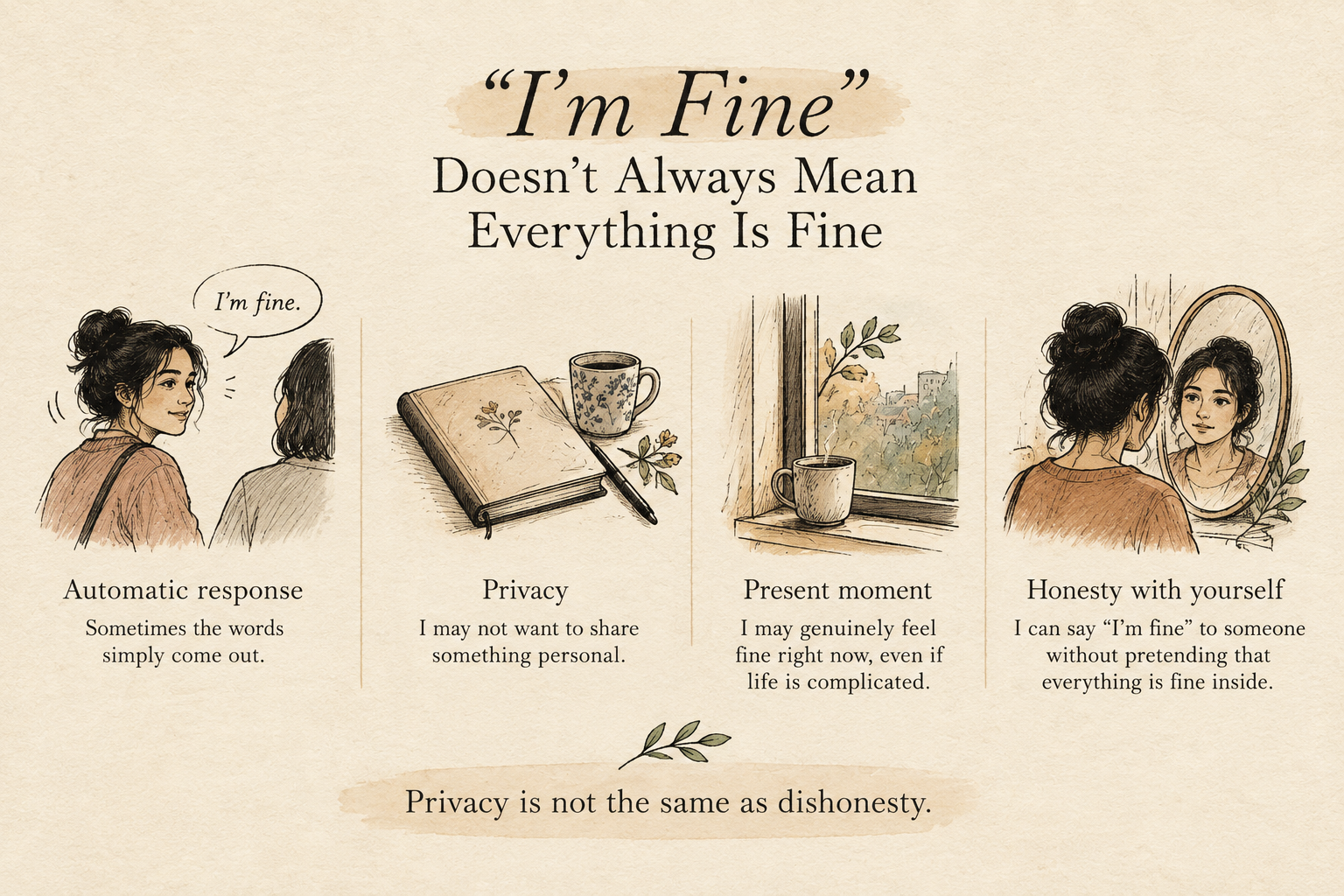
What to Do When You Say “I’m Fine” but You’re Not: A Practical Takeaway
You don’t have to stop saying “I’m fine” just because life isn’t perfect.
The more important question is: Are you being honest with yourself about what is actually going on?
If the answer is yes, then you can choose what to share and with whom.
You can say “I’m fine” to an acquaintance because you don’t want to explain your private life. You can tell a close friend a little more. And you can take the things you don’t want to tell anyone to God or Holy Mother.
Just don’t let “I’m fine” become “nothing is wrong” inside your own mind.
You can know that something is difficult and still have hope.
You can keep some things private and still be honest.
And sometimes, “I’m fine” simply means, “I’m okay right now.”
Why Do I Say ‘I’m Fine’ When I’m Not?” – Final Thoughts
Maybe the next time you say “Why Do I Say ‘I’m Fine’ When I’m Not?”, don’t rush to judge those two words.
Sometimes they are simply the easiest words to say.
What matters more is what you know when the conversation ends — and what you choose to do with that truth.
Frequently Asked Questions
Why do I say “I’m fine” when I’m not?
Sometimes “I’m fine” is simply an automatic response. Sometimes you don’t want to explain something personal. And sometimes you genuinely feel fine in that particular moment, even though other parts of your life are difficult.
Why do I say I’m fine when someone asks how I am?
Because it is an easy, familiar answer to a familiar question. You may also not want the conversation to become personal, especially with someone who doesn’t know you well.
Is it okay to say “I’m fine” when I’m not?
Yes. You don’t have to share your private struggles with everyone. The important thing is not to use “I’m fine” to convince yourself that nothing is wrong when you know there is.






One Comment