
A Simple Question That Helps When You Feel Anxious: 4 Honest Steps
In 2014, I suddenly lost one of my closest friends. Her death was completely unexpected, and the shock broke something inside me. She had been one of the most important people in my life—the person I could talk to about almost anything.
Her death shattered me. I was already going through a difficult period in my life, and suddenly I had to deal with grief, fear, poor health, and a deep sense of uncertainty. I didn’t know what to do when you feel anxious when there seemed to be no way to make things right.
What happened afterward eventually changed the direction of my life in a way I could never have planned. Looking back now, I can see how a small, unexpected moment helped me understand a simple question that helps when you feel anxious—without me even realising it at the time.
Let me tell you what happened.
How to Calm Anxiety When You Feel Overwhelmed
When your mind is racing, how to calm an anxious mind may feel like the only thing that matters. But sometimes, the first step is simply noticing where your attention has gone.
1. Notice Where Your Attention Has Gone
Anxiety can pull your attention away from what is happening now and toward everything that might happen next.
You may start replaying a conversation, imagining a difficult outcome, checking how you feel, or trying to solve a problem that hasn’t happened yet.
Don’t fight the thought. Just notice it.
Where has my attention gone?
That small pause can help you see that you are caught in an anxious loop rather than dealing with an immediate problem.
2. Ask Yourself: “What Needs My Attention Right Now?”
Once you notice that your mind has wandered into worry, don’t immediately ask how to get rid of the anxiety. Ask a more useful question:
What needs my attention right now?
Maybe there is something you genuinely need to handle. Maybe someone needs you, a task needs finishing, or there is a decision you can actually make.
If there is, give that your attention.
And if there isn’t, you don’t have to keep searching for something to worry about. You can let the thought be there without giving it the rest of your day. That’s really a quieter way of learning how to stop overthinking and trust God — not silencing the mind, but no longer needing it to finish every worry.
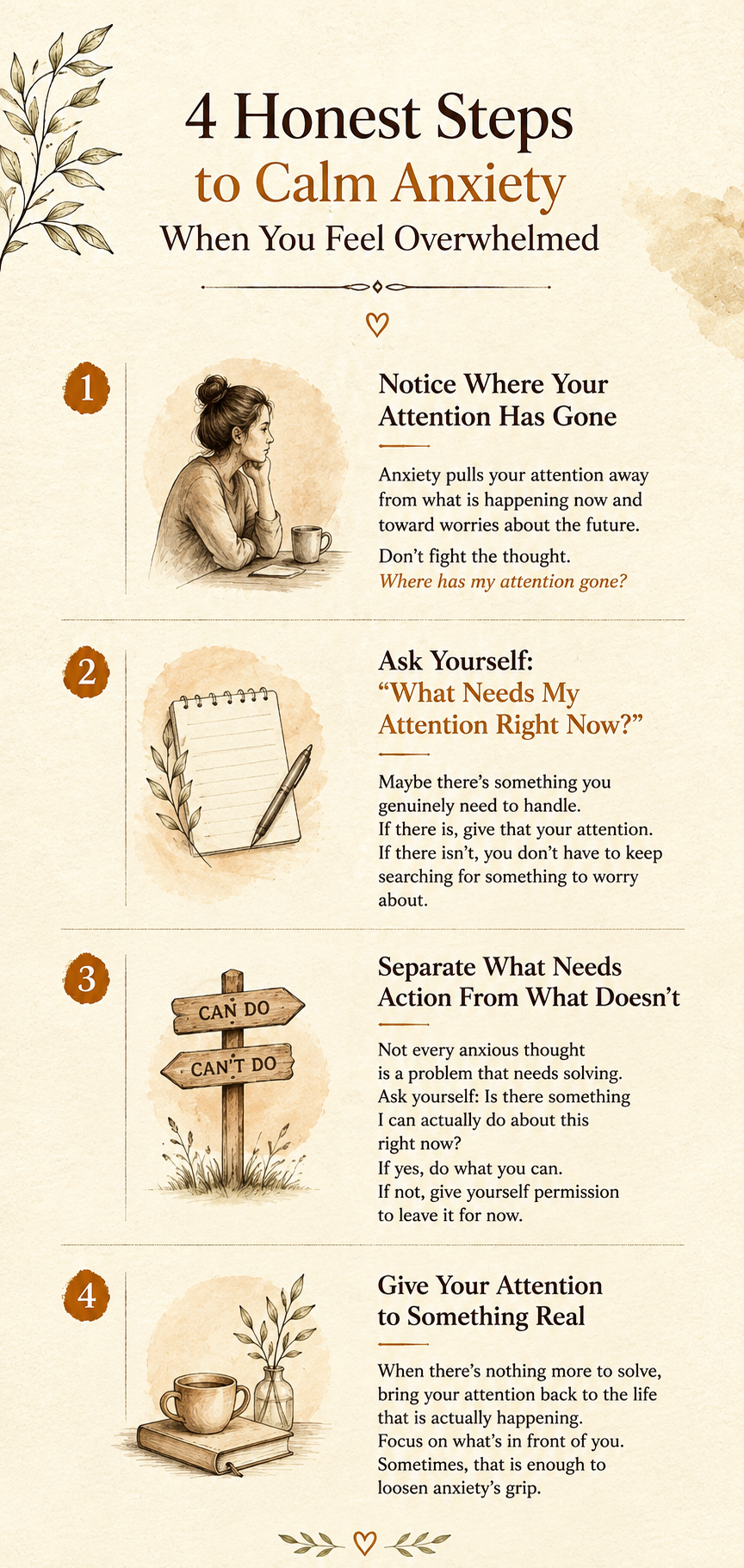
3. Separate What Needs Action From What Doesn’t
Not every anxious thought is a problem that needs solving.
Sometimes there is something you can do. Make the call, send the message, finish the task, or take the next small step.
But sometimes, there is nothing to do yet.
If you’re worrying about something that hasn’t happened, or something you’ve already done everything you can about, more thinking won’t necessarily make you more prepared. It may simply keep your mind stuck there.
Ask yourself: Is there something I can actually do about this right now?
If yes, do what you can. If not, give yourself permission to leave it for now.
4. Give Your Attention to Something Real
When there is nothing more to solve, don’t leave your attention sitting inside the anxious thought. Give it somewhere real to go.
Listen to the person talking to you. Finish the small task in front of you. Notice the sounds around you. Make a cup of tea. Step outside. Care for something that needs you.
This isn’t about distracting yourself from anxiety or pretending you feel fine. It’s about bringing your attention back to the life that is actually happening, instead of spending the moment inside everything that might happen.
Sometimes, that is enough to loosen anxiety’s grip.
A Real Example: A Simple Question That Helps When You Feel Anxious
I did not learn this question during some introspection or a calm phase of my life. I understood its meaning much later, after one of the darkest periods I had ever been through.
As mentioned above, in 2014, one of my closest friends left this world. She was one of those rare people who become a part of your everyday life.
I could discuss almost anything with her—every personal matter, every worry, every little thing. She was, honestly, one of the best people I had ever known.
She had gone to Kolkata for treatment, and I knew she was unwell. We even met at the airport (I was also travelling that day) before she left. She looked weak, but I was hopeful.
Treatment was going on, and I thought she would recover and come back soon. I didn’t know then it would be the last time ever.
A few days later, her elder brother called me and gave me the worst news. She passed away.
The news shattered me.
I had never experienced grief like that before. I was already struggling with several things in my life, and suddenly there was this enormous loss that I couldn’t understand or accept.
My health also suffered badly. I remember feeling so overwhelmed and emotionally numb that it was almost like my body didn’t know how to hold all that emotion. There were repeated asthma episodes, hospital visits, medication, and periods when I needed counselling and therapy.
I had no spiritual practice at that point either. I wasn’t someone who knew how to turn to God when life became unbearable. I was simply trying to get through the days. It was closer to feeling spiritually empty, without knowing that was even the right word for it.
I eventually returned to my hometown for her last rites and the ceremonies after her death. Then I had to go back to the town where I was living.
My train to Jamshedpur was from Howrah.
I had some time before the train, so I don’t know why, but I walked into a Ramakrishna Mission bookstore at Howrah station.

Nobody had sent me there.
I didn’t know any monk or any spiritually advanced friend who could guide me. I had hardly ever visited a Ramakrishna Mission centre, despite one being situated almost opposite the school where I had studied. I had visited it only a couple of times in my life.
Yet that day, mysteriously, I walked into the bookstore and bought The Gospel of Sri Ramakrishna, along with two small illustrated books about the lives of Sri Ramakrishna and Holy Mother Sri Sarada Devi.
Then I boarded my train and went back to Jamshedpur.
At the time, I didn’t think – This is going to change my life.
I wasn’t consciously looking for spiritual guidance. I wasn’t even asking myself a particular question. Something simply drew my attention in that direction.
Only later did I understand how significant that small moment had been. It became the beginning of my spiritual life, and in December 2015, I eventually received diksha.
Looking back, I don’t think the lesson was that I had suddenly found a way to make my anxiety disappear. I hadn’t. My life was still difficult, and I was still carrying a great deal of pain.
But something had shifted.
My attention had, even briefly, moved away from everything I could not control and toward something that was actually in front of me. I had found a book, a place, and eventually a path I hadn’t been looking for.
That is why I now understand a simple question that helps when you feel anxious differently.
Sometimes how to stop anxious thoughts isn’t about answering every thought or figuring out the future. Sometimes it begins with noticing where your attention has gone—and gently giving it somewhere real to go.
You Don’t Have to Solve Every Thought
An anxious thought doesn’t always need an answer. You don’t have to follow every what if or find certainty about something that hasn’t happened. This is close to why can’t I stop overthinking often comes down to believing every thought needs to be finished before you can rest.
Pause. Notice where your attention has gone, and ask yourself what truly needs it right now.
Sometimes, how to calm an anxious mind begins with something much simpler than solving the thought. It begins with returning to the life that is already happening.
And perhaps that is the real gift of a simple question that helps when you feel anxious: it gives you a way to come back to yourself, one moment at a time.
Frequently Asked Questions
What questions should I ask myself when I feel anxious?
When you feel anxious, you don’t necessarily need to find an answer to every thought. Start with simple questions such as: “What needs my attention right now?” and “Is there something I can actually do about this?” These can help you separate a real problem that needs action from a worry about something that hasn’t happened.
How can I stop anxious thoughts from taking over?
You may not be able to stop anxious thoughts from appearing, but you can choose not to give each one your full attention. Notice when your mind has moved into imagined outcomes or future worries, then gently bring your attention back to something real in front of you. A small task, a conversation, or simply noticing your surroundings can help break the loop.
How can I sit with anxiety without trying to fix it?
You can sit with anxiety by allowing the feeling to be there without immediately trying to understand, eliminate, or solve it.
Notice what you’re feeling, remind yourself that not every thought requires action, and return your attention to the present moment. Sometimes learning how to calm an anxious mind is less about making the feeling disappear and more about letting it exist without allowing it to run the whole moment.






One Comment