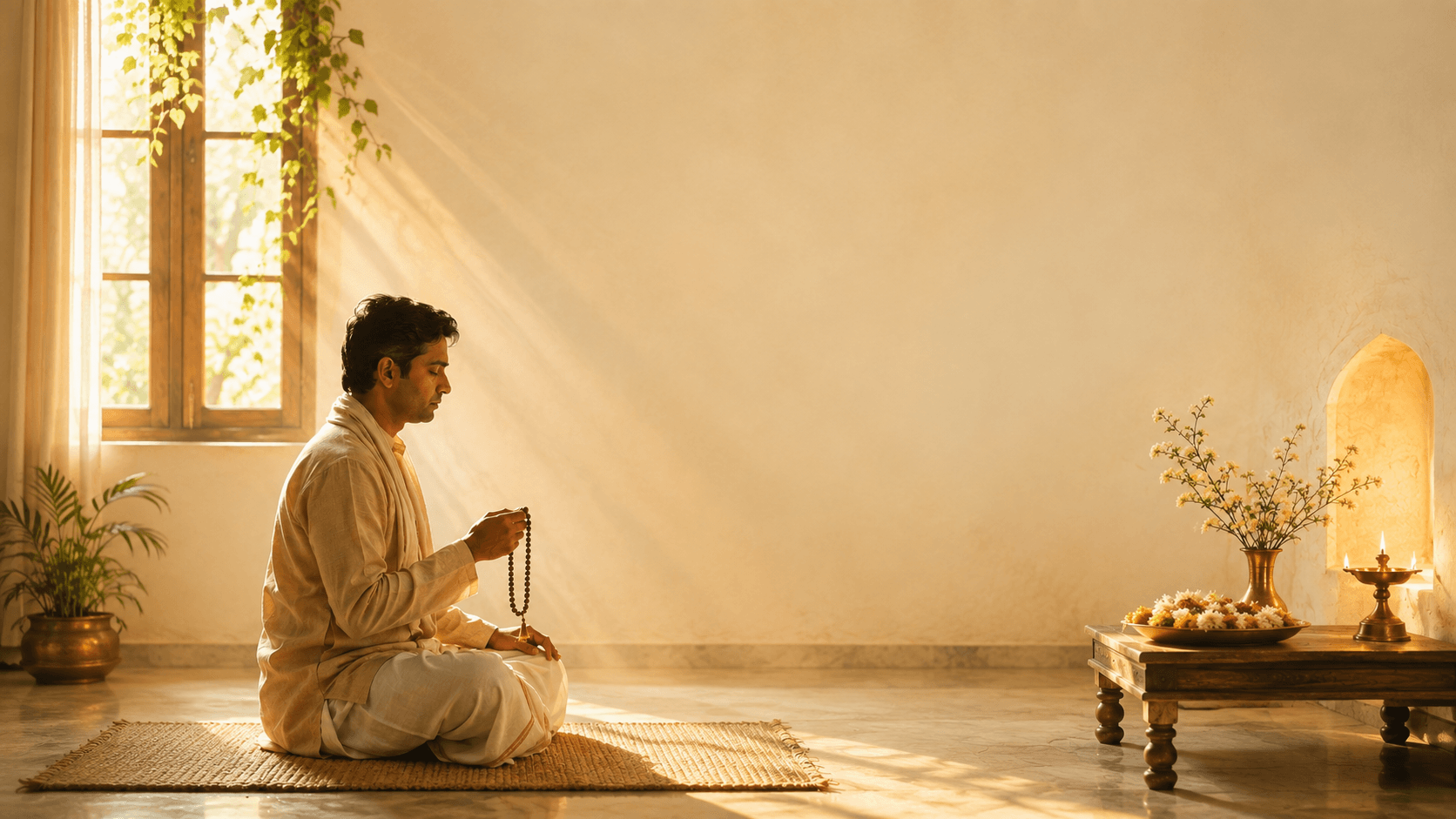
What Is Mantra Japa? 7 Powerful Insights on Meaning, Purpose & Meditation
What is Mantra Japa? There comes a point in your spiritual journey when you begin looking for something deeper than temporary inspiration or generic motivation. You long for a spiritual practice that you can rely on throughout your life… something that stays with you through restless mornings, difficult seasons, and even the ordinary moments in between. You long for something that gently brings your mind back to God, helps you feel protected, and slowly deepens your relationship with the Divine.
If you have ever felt this longing, then the Guru Mantra you receive from your Guru can become one of the greatest blessings in your life.
Through regular repetition, this simple practice gradually becomes much more than a daily discipline. It becomes a quiet companion that walks with you through every stage of life. Over the years, Mantra Japa has the potential to nurture a deeper love for God, strengthen your spirit, and help you see the Divine more clearly in yourself and in those around you.
Yet before you understand the purpose of Mantra Japa, it helps to first understand what is Mantra Japa and its true meaning. Some people think it is simply repeating God’s name. Others wonder whether it is a form of Mantra Japa meditation, while some hesitate because they believe it is meant only for monks and renunciants. If these questions have crossed your mind, they are completely natural.
In this article, we’ll explore the Mantra Japa meaning, why it has remained one of the most cherished spiritual practices across generations, and how understanding its purpose can deepen your relationship with God before you begin or deepen your own practice.
What Is Mantra Japa Meaning?
The Mantra Japa meaning becomes much easier to understand when we first look at the two words separately.
A mantra is much more than a sacred word or a sound repeated again and again. In the Hindu spiritual tradition, a mantra is received from one’s Guru and becomes a lifelong spiritual companion. It is the Divine Name that gently brings the wandering mind back to God.
Swami Sivananda beautifully writes in Japa Yoga:
“Japa is the repetition of any Mantra or Name of the Lord.”
He also explains:
“A Mantra is Divinity. It is divine power or Daivi Sakti manifesting in a sound body.”
I have always found this understanding deeply comforting even during seasons of spiritual emptiness or spiritual loneliness.
When you receive a mantra from your Guru, you are not simply receiving a few sacred syllables to repeat mechanically. You are receiving a living spiritual support that can remain with you throughout your life.
The second word, japa, simply means the repeated remembrance or repetition of that mantra. Traditionally, this is practised by repeating the mantra using a mala to help maintain focus. The repetition is not meant to be mechanical. You can also count the mantra on your fingers. With time, every repetition gradually turns the mind back towards God.
When these two come together, Mantra Japa becomes a complete spiritual practice. Rather than allowing the mind to keep running after countless thoughts, you lovingly give it one sacred name to return to again and again. Over months and years, that repeated remembrance slowly transforms the inner life.
This is also why many people use the expression Mantra Japa meditation. The practice certainly develops concentration and meditation, but the two are not exactly identical.
Swami Sivananda explains that there can be meditation with Japa (Japa Sahita Dhyana) and meditation without Japa (Japa Rahita Dhyana). He recommends that beginners combine meditation with Japa because repeating the Divine Name naturally steadies the mind. As one’s practice deepens, the repetition may gradually become effortless, allowing meditation to continue in a more absorbed state.
I find this distinction very helpful. Many of us think we must first learn how to meditate before beginning spiritual practice. But Japa offers a gentler path. Instead of struggling to stop every thought, you simply return to the Divine Name with sincerity. Over time, concentration develops naturally.
The purpose of repeating a mantra is not merely to complete a certain number of repetitions. One of the most beautiful aspects of Mantra Japa is that the mantra gradually becomes more than a daily practice. It becomes something you can return to during your mundane routine. Slowly, almost without noticing it, God’s Name begins to accompany your life.
That is the real Mantra Japa meaning. It is not simply repeating sacred words. It is a lifelong practice of remembering God with faith, devotion, and love.
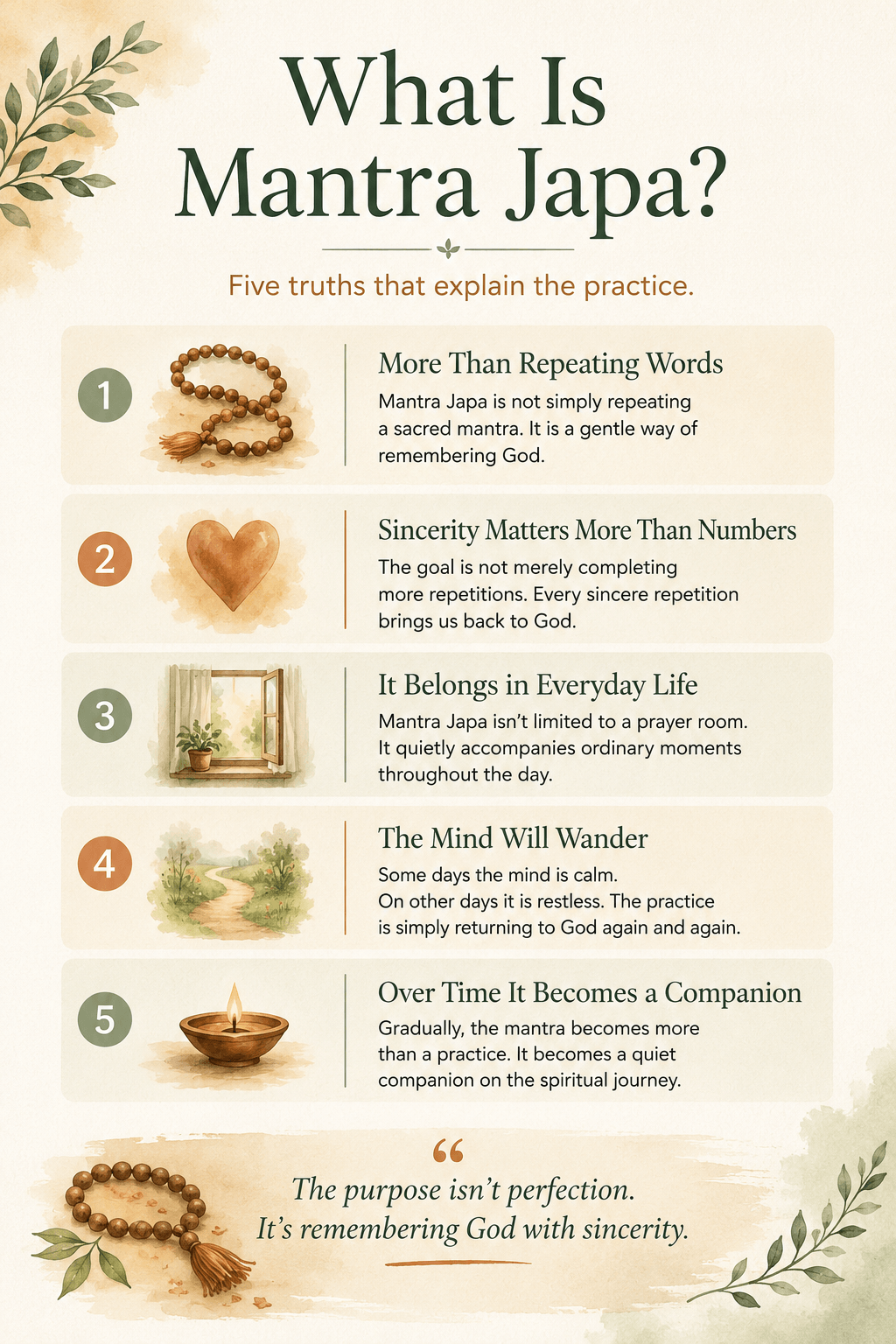
What Is the Purpose of Mantra Japa?
At first glance, Mantra Japa may seem like simply repeating a sacred mantra again and again. But over the years, I have realised that its purpose goes far beyond repetition. The scriptures describe many spiritual fruits of Japa, and saints like Swami Sivananda have written extensively about its transformative power.
While I am still a beginner on this lifelong journey and am still learning to surrender more completely to God… however, by Divine grace, I can honestly say that sincere and regular practice quietly changes you from within.
The highest purpose of Mantra Japa, according to the scriptures, is God-realisation.
But for most of us, that journey begins much more simply. It begins by remembering God a little more today than we did yesterday… by slowly bringing the mind back whenever it wanders… and by allowing the Divine Name to become part of our everyday life.
Here are three purposes of Mantra Japa that I have gradually come to understand through my own practice. These pointers also may help you overcome overthinking and trust God.
To Remember God Throughout Life
If there is one thing I have learnt over the years, it is that the mind rarely stays where we want it to stay. Even on ordinary days, it keeps moving from one thought to another.
Sometimes I may be writing an article, and suddenly the mind begins questioning everything. It tells me, “You are writing about the purpose of Mantra Japa, but have you achieved any of these things yourself?”
Before I realise it, I have drifted away from both my work and my mantra, and suddenly find myself unable to stop overthinking.
I don’t think this is unique to me. The mind naturally gets distracted, worries about the future, replays the past, or creates doubts where there may not even be a problem.
This is where Mantra Japa has helped me the most.
Rather than trying to suppress every negative thought, I try to replace it with the mantra. Sometimes I gently bring the mind back. Sometimes I have to firmly tell myself, “Enough. Stop now,” and begin chanting again, even if it feels mechanical at first. Slowly, the mind settles.
That, to me, is one of the most beautiful purposes of Mantra Japa. It gives the mind a sacred direction. Instead of allowing every passing thought to lead us wherever it wants, we keep returning to God’s Name. Every repetition becomes another opportunity to remember our Ishta Devata, and to gently turn back towards God.
I cannot say I remember God every moment of the day. I am still learning. But I can honestly say that the mantra has made it much easier to remember Him throughout the day than I ever could on my own.
To Gradually Purify and Steady the Mind
One lesson that Mantra Japa has taught me is that inner transformation is usually very quiet. We often expect dramatic experiences, but in my own life the changes have been gradual, almost so gradual that I noticed them only after looking back over the years.
Swami Sivananda beautifully compares the mind to a mirror. When dust covers a mirror, it cannot reflect clearly. As the dust is gently removed, the reflection becomes brighter. In the same way, he explains that regular Japa gradually removes the impurities of the mind, allowing our true spiritual nature to shine more clearly.
Swami Sivananda on Regular Mantra Japa
I have found this to be a helpful way of understanding the practice. Mantra Japa has not made my life free from challenges, nor has it suddenly stopped my mind from wandering. But with Mother’s grace, I have noticed something changing within me.
My patience has slowly increased. There is a different kind of inner calm and strength that I cannot easily explain. More importantly, my reaction span has changed. Situations that once made me react immediately now often give me a small pause. In that pause, I find a little more clarity before responding.
I can’t say this has happened every single time. It certainly hasn’t. But I can see enough change to know that regular practice has been quietly working within me.
This is why patience is so important in Mantra Japa. We may not notice its effects after a few days or even a few weeks. But if we continue sincerely, year after year, the practice slowly steadies the mind. Looking back, you may realise that something inside you has become calmer, stronger, and a little more peaceful than before.
To Deepen Our Relationship With God
Ultimately, I believe the purpose of Mantra Japa is not simply to complete certain rounds of chanting. It is to deepen our relationship with God.
In the beginning, we consciously make an effort to remember the mantra. But over time, something begins to change. The mantra starts accompanying us through ordinary life.
I have experienced this many times.
Sometimes an urgent piece of work comes up, or something unexpected demands all of my attention. After a while, I suddenly realise, “Oh… I haven’t been chanting my mantra.”
That small moment tells me something beautiful. It tells me that the mantra has become part of my daily life. I miss it when it isn’t there.
There are also days when I am not able to complete the number of rounds I had hoped to do. On those days, I sometimes feel guilty. Then I remind myself that God is not attained by merely achieving a target number of repetitions. I simply try to do my best with sincerity, keeping in mind the circumstances of that day.
Personal Reflection on Mantra Japa
Even so, I think that little feeling of missing the mantra has its own beauty. When you genuinely care about someone, you naturally miss spending time with them. In the same way, with God’s grace, regular Mantra Japa slowly increases our love for Him.
We may not experience the lofty states described by great saints or advanced practitioners. I certainly cannot claim that. But I do believe that every sincere repetition quietly strengthens our connection with God.
Over time, the mantra becomes much more than a daily practice. It becomes a companion. It becomes the gentle thread that keeps bringing us back to the One we love, again and again.
Many people don’t begin mantra japa because someone tells them to.
They begin because something within them quietly longs for a different way of living. Some find themselves asking why they feel like they don’t fit into the world everyone else is chasing, even when life appears perfectly fine on the outside. Questions like these often become the beginning of a sincere spiritual search.
What is Mantra Japa: Bringing It All Together
So, what is Mantra Japa?
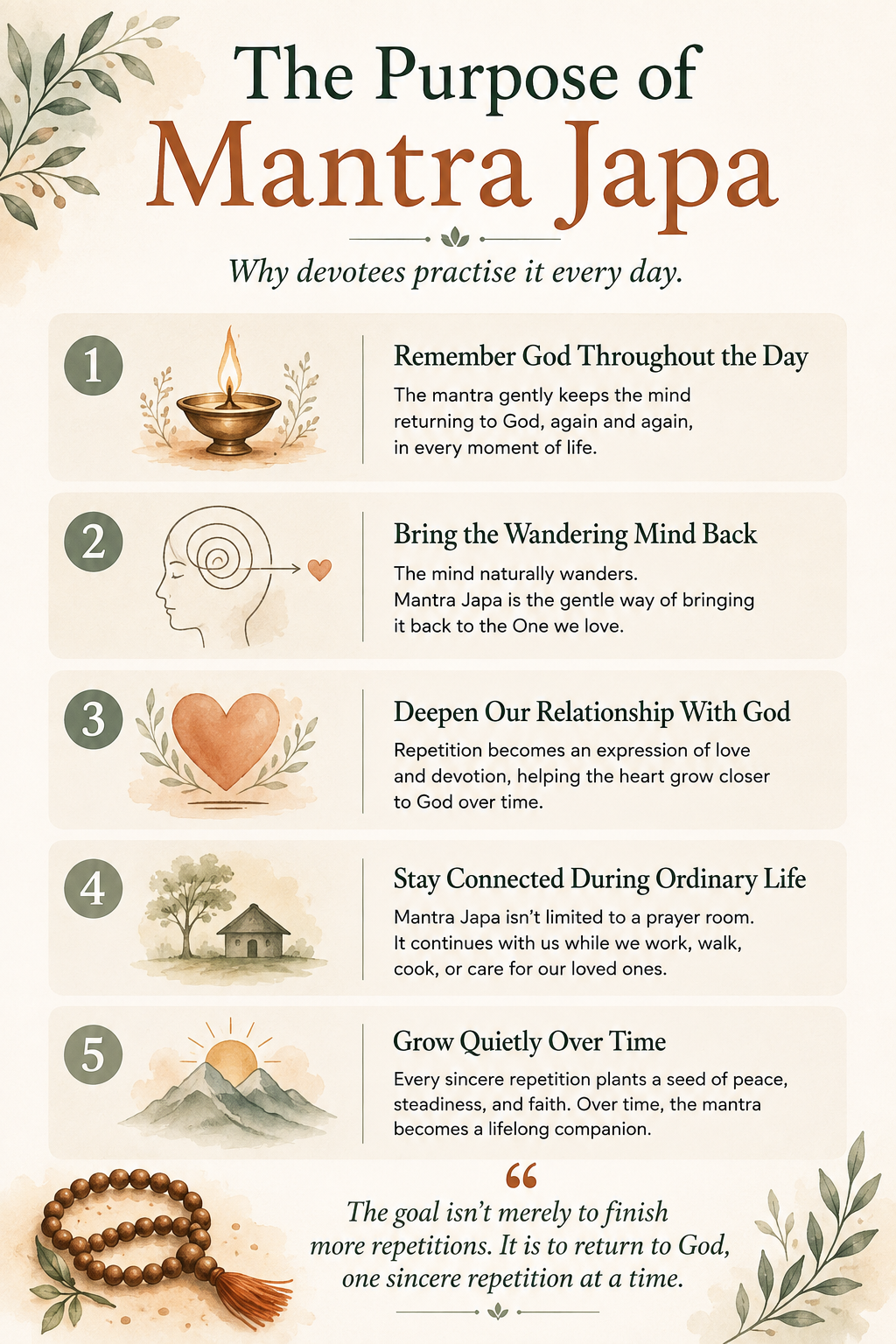
After years of practising it, I don’t think it is simply the repetition of a sacred mantra. For me, it has become a gentle way of remembering God through the ordinary moments of life. Some days the mind is calm. On other days it is restless. Yet the mantra patiently teaches us to return to God again and again.
The Mantra Japa meaning has also become clearer to me with time. It is not about chasing extraordinary spiritual experiences or trying to become perfect overnight. It is about showing up every day with sincerity, even when the mind wanders, and trusting that God is quietly working within us in ways we may not immediately notice.
The purpose of Mantra Japa is not just to complete 40 or 50 malas a day. It is to gradually purify the mind, deepen our love for God, and gently draw us closer to Him. With His grace, what begins as a daily practice slowly becomes a lifelong companionship.
If you are just beginning your journey, don’t worry if your mind keeps getting distracted. Mine still does. Don’t wait for the perfect mood or the perfect level of concentration. Simply begin where you are and return to your mantra with faith and patience. Every sincere repetition matters.
Over time, you may discover that Mantra Japa meditation is not about forcing the mind into silence. It is about lovingly bringing it back to God’s Name until that remembrance becomes more natural than distraction itself.
One practice that has helped me alongside Mantra Japa is offering a completely honest dialogue with God, as seen in Bhagavad Gita 2.7. This helps, especially on days when I feel weak, confused, or unable to concentrate.
Perhaps that is the simplest way to understand what is Mantra Japa. It is not about chanting perfectly. It is about returning to God, one mantra at a time, with sincerity, patience, and love… trusting that every step taken towards Him is met by His infinite grace.
What is Mantra Japa: A Quiet Reflection
Over the years, I’ve slowly realised that the mantra is not merely something I chant. It has quietly become my closest companion through joy, confusion, fear, and hope.
In many ways, the mantra has quietly become my best friend… because it keeps bringing me back to God.
Frequently Asked Questions
What is Mantra Japa?
Mantra Japa is the spiritual practice of repeatedly chanting or mentally repeating a sacred mantra received from one’s Guru or followed within a spiritual tradition. The purpose is not simply to repeat words, but to gently keep bringing the mind back to God with faith and devotion. Over time, this simple practice becomes a way of remembering the Divine throughout everyday life. For many spiritual seekers, Mantra Japa gradually becomes a lifelong companion rather than just a daily ritual.
What is Japa in Hinduism?
In Hinduism, Japa refers to the repeated remembrance of a Divine Name or sacred mantra. It is considered one of the simplest and most accessible spiritual practices because it can be done almost anywhere with sincerity and concentration. Different traditions may follow different mantras, but the underlying purpose remains the same: to help the mind turn towards God instead of constantly running after worldly distractions. Many devotees practise Japa daily as part of their spiritual discipline.
What is Japa Sadhana?
Japa Sadhana is the regular and disciplined practice of Mantra Japa as part of one’s spiritual journey. The word sadhana means a dedicated spiritual practice undertaken with patience, sincerity, and perseverance. Rather than expecting immediate results, Japa Sadhana encourages us to continue chanting with faith, trusting that inner transformation happens gradually through God’s grace. Like any meaningful practice, its depth grows with consistency over time.
Is Jaap Mantra the same as Mantra Japa?
Yes, in everyday conversation, people often use the terms Jaap Mantra and Mantra Japa to refer to the same practice of repeating a sacred mantra. However, Mantra Japa is the more commonly used and grammatically accurate expression in spiritual literature. Regardless of the wording, the focus remains on remembering God with devotion rather than on the terminology itself. What matters most is practising the mantra with sincerity and faith.
What does a mantra do?
A mantra gives the mind a sacred point of focus. Instead of becoming completely absorbed in worries, distractions, or unnecessary thoughts, we learn to gently return to the Divine Name again and again. With regular practice, many people notice greater inner steadiness, patience, and a deeper connection with God. While each person’s journey is unique, a mantra can quietly become a source of strength, comfort, and spiritual companionship throughout life.





5 Comments