
Why Do I Struggle With Uncertainty? 3 Powerful Ways
A few weeks ago, I received some news that shocked me.
It was about a betrayal. But it was not just betrayal. The situation was much more complicated than that, and somehow, I was involved in it too—without even knowing what was happening.
Being betrayed is painful enough. It can break something inside you. It can make you question the trust you placed in someone, and sometimes even make you question things you had taken for granted in your own life.
But this was more than that.
There was a complicated situation unfolding around me, and although I had not created it and had very little to do with it, there was a possibility that my name could be dragged into it.
And the hardest part?
There was almost nothing I could do.
I had no way of making the situation turn in my favour. I had no action left to take. I could not control what other people would say, what they would do, or what would happen next.
So I kept offering the whole situation to Mother.
I knew I had not done anything wrong. I knew the situation was not in my hands. Somewhere inside me, there was even a faint faith that Mother was taking care of it.
And yet, for almost two weeks, my mind kept returning to the same question:
What is going to happen?
I would pray, and then wonder again.
I would remind myself that I could do nothing, and then think about the outcome again.
I knew I could not control it.
But I still kept trying to find some way to know what would happen.
That experience made me look at my own struggle with uncertainty in a different way.
Maybe this is what makes uncertainty so difficult. It is not always that we want to control everything. Sometimes we already know that we cannot control anything. What we really want is a guarantee that things will be okay.
We want to know how the story will end.
And when we cannot know, we start looking for reassurance. We check. We think. We imagine different outcomes. We look for signs. We try to find one more piece of information that might finally make us feel safe.
But there is another part of this that I am still learning myself.
I know that Mother is in control. I know that She knows what I cannot know. I know that She is protecting me.
The difficulty is developing the depth of faith where I can truly remain steady in that knowledge even when I cannot see what She is doing.
And perhaps that is where dealing with uncertainty becomes more than a matter of learning how to calm the mind.
Perhaps it is also about learning to trust the One who can see what I cannot.
In this article, I want to look honestly at why we struggle with uncertainty, what that struggle makes us do, and how we can respond differently… by doing what is ours to do, leaving what is not in our hands, and slowly learning to trust Mother with the rest.
What Happens When You Struggle With Uncertainty?
When I struggle with uncertainty, I may already know that I cannot control the situation.
And still, my mind keeps going back to it.
I may tell myself, “There is nothing more I can do.” But five minutes later, I am thinking about the same thing again.
What if this happens?
What if that happens?
What will they do?
What will happen to me?
Will everything be okay?
This is where the struggle with uncertainty becomes exhausting. The situation itself may be difficult, but the mind does not stop at the difficulty. It wants to know the outcome.
And that is where I think many of us get caught.
We want certainty because we want to feel safe
I don’t think most of us are actually looking for control in the way we usually understand control.
Deep down, we know we cannot control another person’s decision. We cannot control what someone will say. We cannot control how a situation will unfold. We cannot control whether a plan will work.
Yet we still want to know.
Why?
Because if I know what is going to happen, I feel safer.
If I know that my relationship will be okay, I can relax.
If I know that the decision I made will work out, I can stop questioning it.
If I know that something I have worked hard for will succeed, I don’t have to keep wondering whether all my effort will lead anywhere.
We want the guarantee.
That is why fear of uncertainty can be so powerful. It is not always the unknown itself that frightens us. It is what the unknown leaves open.
Something could go wrong.
Something could be lost.
Someone could change their mind.
A decision could turn out to be a mistake.
And because we don’t know, the mind keeps trying to find out.
When you cannot know, the mind starts trying to predict.
This is one of the strangest parts of struggling with uncertainty.
I can know that thinking about something will not change the outcome.
And I can still think about it for hours.
I can know that I have already done everything I can.
And I can still go over the situation again.
I can know that another person has the freedom to do whatever they choose.
And I can still try to understand what they might be thinking.
It is almost as if the mind believes that if it studies the situation long enough, it will somehow discover the future.
I have written more about this kind of mental loop in Bhagavad Gita on overthinking, because sometimes knowing that something is not in our hands still does not stop the mind from going back to it.
So we imagine different outcomes.
We replay conversations.
We search for clues.
We try to read signs.
We look for patterns.
We ask ourselves what we should have done differently.
And sometimes we search for one more piece of information because we believe that this time it might finally make everything clear.
But the future remains the future.
We still don’t know.
We start looking for reassurance
This is where coping with uncertainty can become difficult.
When I don’t know what is going to happen, reassurance can feel like relief.
Someone tells me, “Don’t worry. Everything will be fine.”
For a moment, I feel better.
So the next time uncertainty comes, I may look for reassurance again.
Or I may check something again.
Or ask the same question again.
Or look for another sign.
Or search for more information.
The reason is simple: I want the uncomfortable uncertainty to end.
And sometimes this can become a loop.
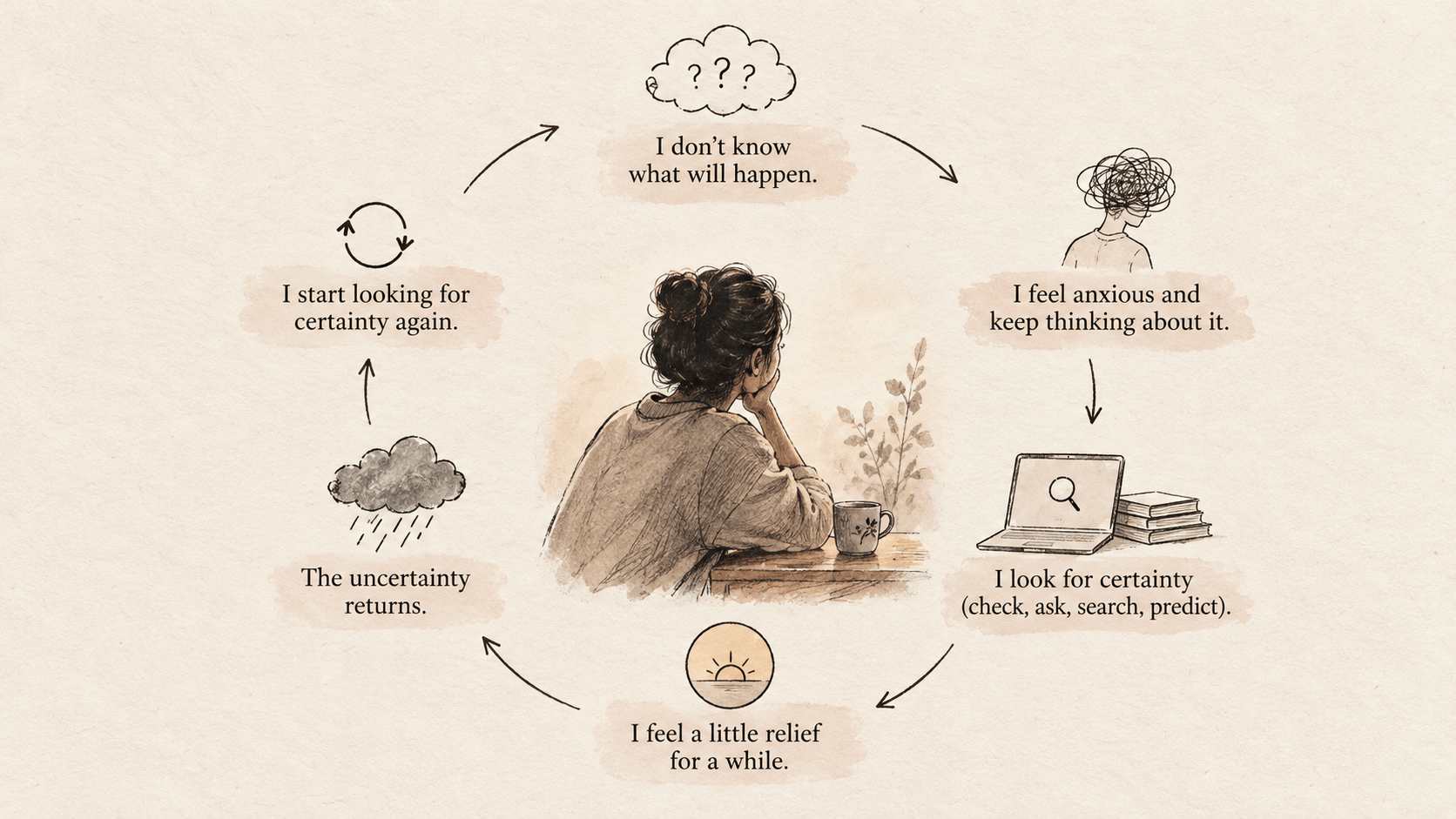
I don’t know → I become anxious → I look for certainty → I feel temporary relief → uncertainty returns → I look for certainty again.
The problem is that reassurance may calm me for a moment without teaching me how to sit with what I still don’t know.
Sometimes, when the mind becomes too restless, prayer itself can become a place to bring those thoughts. Knowing how to pray and what you should pray for may help you put some of those feelings into words.
Sometimes we make a decision just to end the uncertainty
This is another place where struggling with uncertainty can quietly influence our choices.
Sometimes I am not asking:
“What is the right thing for me to do?”
I am asking:
“What can I do so that I don’t have to feel this uncertainty anymore?”
Those are not the same question.
I may end something because waiting has become unbearable.
I may say yes or no too quickly because I cannot stand sitting in the middle.
I may walk away from something simply because I want an answer.
Or I may avoid making the decision at all because choosing means accepting that I cannot guarantee what will happen afterwards.
The decision can then become an escape route.
Not necessarily the right decision.
Just a decision that makes the uncertainty stop.
But some uncertainty remains even after we do everything right
This, to me, is the hardest part.
There is a kind of uncertainty that comes after you have done your part.
You have spoken honestly.
You have made the effort.
You have taken the responsible step.
You have prayed.
You have worked.
You have done what you could.
And still, there is no guarantee.

This is where I find dealing with uncertainty much harder.
Because I cannot tell myself, “I just need to do something.”
Maybe I have already done it.
Now I have to wait.
Now I have to live without knowing.
And that is where I have to face something I don’t always want to face:
I cannot make the outcome happen just because I desperately want to know what it will be.
I can keep thinking about it.
I can keep checking.
I can keep trying to predict it.
But none of that gives me control over the future.
And this is where my faith becomes important.
I know that Mother is in control.
I know that She knows what I cannot know.
I know that She is protecting me.
But I also know that having this knowledge and having the deepest faith in it are not always the same thing.
My mind may still ask, “But what is going to happen?”
And perhaps this is one of the deepest parts of learning to live with uncertainty: learning to remain with the question when I don’t have the answer.
Not because the situation doesn’t matter.
Not because I should stop taking responsibility.
But because there are things I can do—and there are things I have to leave to Mother.
That distinction is where we can begin to find a different way of coping with uncertainty.
How to Deal With Uncertainty Without Losing Yourself
You cannot make every uncertain situation certain.
You cannot know what another person will decide. You cannot know exactly how your work will turn out. You cannot know what the future will bring.
And you don’t need to.
For me, dealing with uncertainty is slowly learning to live with what I cannot know without allowing it to take over my mind.
These three things can help.
1. Separate What You Know From What You Fear
When you struggle with uncertainty, the mind can quietly turn possibilities into facts.
You know something has happened.
But then you start thinking about what might happen.
And after thinking about it long enough, the possibility starts feeling almost like reality.
So stop and ask yourself:
What do I actually know?
And then:
What am I afraid might happen?
These are not the same thing.
You may know that someone has not replied. You don’t know why.
You may know that your work is not producing the result you hoped for yet. You don’t know that it will never work or it might just click at any moment.
You may know that a situation is difficult. You don’t know how it will end.
This simple distinction can bring some clarity.
And when you notice yourself checking, searching, predicting, or going over the same situation again, ask yourself:
“Am I learning something new, or am I trying to get a guarantee?”
That question can stop you in your tracks.
2. Don’t Make a Decision Just to Escape Uncertainty
Sometimes the strongest urge is to do something.
Anything.
You want the waiting to stop. You want the questioning to stop. You want the uncertainty to stop.
So you make a decision.
But ask yourself honestly:
“Am I making this decision because I truly believe it is the right thing to do, or because I cannot tolerate not knowing what will happen?”
There is a difference.
If you have something useful to do, do it.
If you need to communicate, communicate.
If you need to take responsibility for something, take it.
But don’t create an action simply because you want relief.
Sometimes the most responsible thing you can do is nothing more.
You have already done your part.
Now there is nothing left to control.
And this is where coping with uncertainty becomes difficult—and meaningful.
You have to allow the situation to remain unfinished.
You have to let the answer come when it comes.
You have to resist the temptation to keep touching the wound just to check whether it still hurts.
3. Do What Is Yours to Do. Leave the Outcome to Mother.
This is where my understanding of dealing with uncertainty becomes deeply connected with faith.
I know I am not in control.
I may feel that I am making decisions, planning my life, and managing situations. But ultimately, I believe that everything is under Mother’s control.

So what is actually mine to do?
I can act honestly.
I can correct my mistakes.
I can work.
I can pray.
I can practise my mantra japa.
I can use my limited discernment ability.
I can refuse to take revenge when someone has hurt me.
I can do what I believe is right.
But I cannot control the outcome.
And I don’t believe I need to.
Mother knows what I cannot know.
When I cannot see what She is doing, I can still believe that She is protecting me.
That faith may not always come easily to me. I am still developing it. But I believe that deeper faith comes with Mother’s Kripa.
The more that faith deepens, the less I need a guarantee from life.
I can slowly reach a place where I can say:
“I don’t know what will happen. But Mother knows.”
And:
“I will do what is mine to do. The rest is Hers.”
That is not giving up.
That is surrender.
And surrender does not mean that you stop acting. It means that you stop pretending that the entire outcome belongs to you.
You may still feel afraid.
You may still have questions.
You may still struggle with uncertainty.
But you don’t have to let that uncertainty decide your next move.
Take the next step you can take. Leave the next outcome to Mother.
Learning to Be at Peace With What I Cannot Know
I still struggle with uncertainty sometimes.
Maybe I always will, in some form.
But I am learning that I don’t need to have an answer for every question that comes into my mind. I don’t need to see the whole picture before I take the next step.
I can keep doing what is right.
I can keep praying.
I can keep trusting.
And when my mind asks again, “But what is going to happen?”, I can remind myself:
Mother already knows.
I may not have the faith I wish I had yet. But with Her Kripa, I believe I am learning.
And perhaps that is what coping with uncertainty really means for me—not becoming certain about life, but becoming certain about where I place my trust.
When You’re Living With Questions That Have No Answers Yet
Uncertainty can leave you with thoughts that keep asking for an answer even when there isn’t one yet. Writing can sometimes help you stay with those questions without letting them take over your entire inner world.
My 7-day reflective journal offers guided exercises to help you examine your thoughts, emotions, and spiritual experiences with greater honesty and self-awareness.
[Explore the 7-Day Reflective Journal →]
Frequently Asked Questions
1. Why do I struggle so much with uncertainty?
You may struggle with uncertainty because you want to know what will happen before you can feel safe. Even when you know that an outcome is not in your control, your mind may keep checking, predicting, or searching for reassurance. Sometimes, what you are really seeking is not control but a guarantee that everything will be okay.
2. How can I overcome my fear of uncertainty?
You don’t overcome the fear of uncertainty by making every situation certain. Start by separating what you know from what you fear, and notice when you are trying to force an answer simply to feel better. With deeper faith, you can also learn to trust God with what you cannot see or control.
3. How can I deal with uncertainty about the future?
When dealing with uncertainty about the future, focus on what is actually yours to do today rather than trying to predict the entire outcome. You may not know where your life is going, but you can still take the next right step. If you have faith in God, you can also place the part you cannot control in His hands.
4. How can I cope with uncertainty in my relationships?
Coping with uncertainty in relationships means accepting that you cannot know or control another person’s thoughts, feelings, or next decision. Communicate when something genuinely needs to be communicated, but be careful not to turn repeated checking or reassurance-seeking into a way of calming yourself. Sometimes you have to let another person’s silence remain unanswered for a while.
5. Is uncertainty the root of anxiety?
Uncertainty is not necessarily the root of every person’s anxiety, but difficulty tolerating uncertainty can make anxiety much stronger. When you constantly try to predict, check, or secure a guarantee about what will happen, the uncertainty can become even harder to bear. Learning to live without an immediate answer can therefore change your relationship with anxiety.




3 Comments