
How to Stop Overthinking and Trust God: A Practical, God-Centred Perspective
I realised a very strange thing over the years.
You simply cannot overthink your way out of a situation that is making you overthink.
Read that again.
You simply cannot overthink your way out of a situation that is making you overthink.
And that is exactly what most of us do.
So… I have already given you the simple gist of this entire article in the very beginning.
If you genuinely understand this one sentence, maybe you don’t even need to read the rest of this article. But if you’re looking for practical ways of how to stop overthinking and trust God, then keep reading.
Now, in my case, I was a professional overthinker, and for years I genuinely wondered why can’t I stop overthinking. No, I’m definitely not proud of it. Whenever something negative happened, I would overthink it until I created even more negativity around it.
Looking back, I realised it wasn’t just overthinking.
I was also someone who overgave in relationships, overcared, overloved, and overinvested emotionally. Everything was always “over” for me. For years, I saw these as negative traits because they cost me many relationships and friendships.
That made me stop and ask myself:
Maybe I really am too much for people.
Is there actually something wrong with me?
After months of contemplation and working on myself, I understood something very clearly.
I never struggled because I lacked information.
Whenever a difficult situation came into my life, it wasn’t that I didn’t know what to do. My real struggle was that my mind was constantly searching for the next perfect answer.
For example, I would finally decide, “This is what I should do.”
Almost immediately, another part of my mind would interrupt:
“No… maybe this isn’t the best solution. What if there’s a better one?”
Then another possibility.
Then another.
Then another.
Without realising it, I had created endless mental loops that only made things worse… and eventually, from worse to worst.
That was when I truly understood the “cheat code” I mentioned above.
Overthinking was never going to solve the problem.
I had to find another way.
The problem was that I had become completely exhausted by the solutions available on the internet.
Please don’t misunderstand me.
I don’t mean to disrespect anyone who creates videos, reels, or articles about overthinking. Those resources genuinely help many people.
I simply mean that they weren’t helping me.
I wasn’t looking for another productivity trick.
I needed answers from within.
Then another thought came to me.
If my mind had developed this habit of constantly searching for the perfect answer…
Why not start looking for that answer in God instead of outside?
That question changed something inside me.
After years of struggling with overthinking, I slowly realised that overthinking is simply another form of trying to control life on your own terms.
We want a particular outcome.
We want it to happen exactly the way we imagined.
If it doesn’t, we start analysing everything, questioning everything, and overthinking every possibility.
The strange part is that we often don’t even realise we’re doing it.
Our minds become so conditioned from childhood to control outcomes that it almost feels automatic. We want life to unfold exactly according to our plans. Even if life shifts by half a percent, we become anxious… even though that different outcome might actually be better for us, or perhaps exactly what we needed.
That constant need for certainty makes us overthink.
It makes us overanalyse.
And it keeps us searching for the “perfect” move, something that rarely exists in real life.
When I realised this, with God’s grace, I decided to surrender myself to Him.
At least… mechanically.
I’m not saying I suddenly became a great devotee or reached some advanced stage of devotion.
Not at all.
It’s still a learning curve.
It’s still a work in progress.
I don’t think I have surrendered completely even today.
But I thought to myself:
“I trust God. So if I truly trust Him, why not trust Him fully… at least this once?”
I had already become tired of trying everything else.
Nothing seemed to be working.
So I decided to approach this from a devotional perspective and simply see what happened next.
Did all my problems disappear overnight?
No.
Did my doubts suddenly vanish?
No.
Did I wake up one morning and experience some dramatic miracle?
Nothing like that happened.
But something far more important happened.
Slowly, the need to have every answer immediately began to reduce.
The urge to control everything became weaker.
And for the first time in years, my mind slowly began to experience moments of peace.
Maybe you’re here for the same reason I was.
I believe you already love God in your own way.
You’re not here because you’re looking for another productivity hack or another recycled article on overthinking.
You’re here because you’re genuinely tired of carrying every thought by yourself.
And maybe, just like me, you’re no longer looking for more information.
You’re looking for something that actually helps.
With God’s grace, I found a few simple shifts that genuinely changed the way I deal with overthinking.
I hope they help you, too.
So, let’s move to the main part of the article and explore how to stop overthinking and trust God.
How to Stop Overthinking and Trust God: 5 Practical Steps
Here are 5 practical steps to help you how to stop overthinking and trust God.
Stop Treating Every Thought as a Problem You Must Solve
Speaking as someone who has spent years overthinking, I can say this with absolute confidence: overthinkers become specialists at giving every single thought equal importance.
The problem is… not every thought deserves your attention.
Yet overthinkers often believe every thought must be analysed, understood, and solved. That habit quietly keeps the cycle of overthinking alive.
One thing that has genuinely helped me over the last few months, with God’s grace, is changing the way I respond to negative thoughts.
Earlier, I used to entertain them.
Now, I dismiss them immediately.
And I don’t do it politely.
I respond with firm, no-nonsense language, almost as if I’m speaking to someone who has been disturbing my peace for far too long. I treat the thought like an unwanted visitor rather than something that deserves a seat at my table.
It may sound strange, but it genuinely works for me.
I no longer treat every thought as if it were me.
I treat it as something trying to pull my attention away from the present moment.
Sometimes the same thought comes back a few minutes later.
That’s okay.
I dismiss it again.
And if it comes back again…
I dismiss it again.
Without guilt.
Without negotiation.
Without analysing it for the hundredth time.
Now, you don’t have to respond the way I do.
If you’re able to simply notice the thought and let it pass peacefully, that’s wonderful.
But if you’ve been overthinking for years, you probably already know that simply “letting it pass” isn’t always that easy.
Sometimes, you need to respond with a language you would use for someone trying to bully you or poke an insult at you. Sometimes you have to have enough firmness that your mind finally understands:
“No. I’m not giving you my attention today.”
Think of it like clearing out a wardrobe.
There’s an old object you’ve been meaning to throw away for months.
Every time you open the wardrobe, you see it.
Every time you think,
“I’ll remove it later.”
One day, you finally pick it up and throw it away without thinking twice.
Treat unnecessary thoughts with that same energy.
And then…
Immediately come back to whatever you were doing.
If you were cooking, return to cooking.
If you were reading, continue reading.
If you were working, return to your work.
Don’t continue the conversation with the thought.
Let your attention return to the present moment instead.
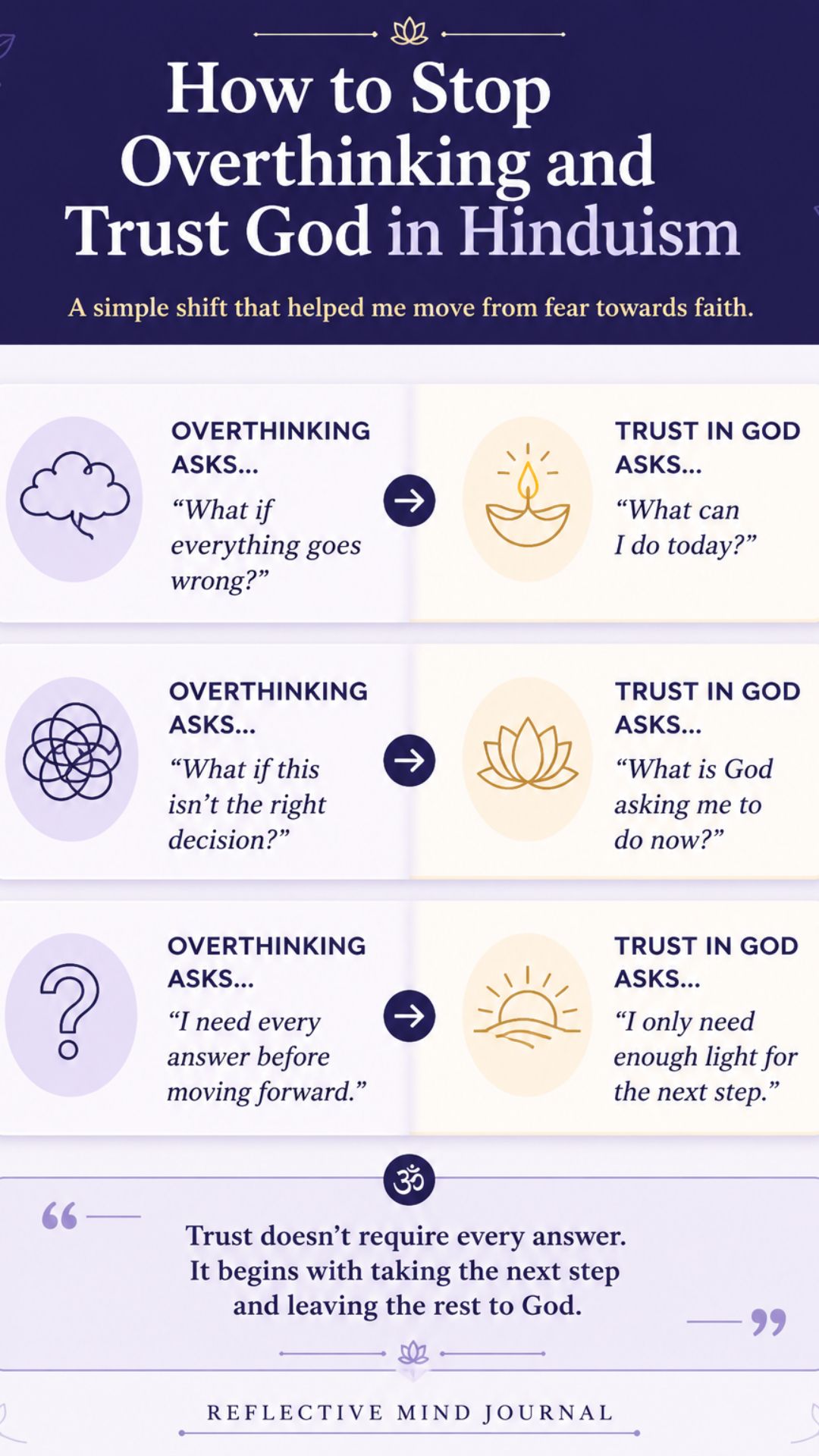
Stop Asking “What If?” and Begin Asking “What Now?”
One thing I have noticed about overthinking is that it almost always pulls us away from the present moment.
Suppose you’re reading a book, working, or simply going about your day. Suddenly, one sentence, one memory, or one small trigger reminds you of something from your past… or something fearful that might happen in the future.
Before you even realise it, your mind has drifted away into an imaginary situation.
Most of our overthinking isn’t about positive possibilities.
It’s usually about everything that could go wrong.
The moment you notice this happening, immediately shift your attention towards God.
Offer that thought to Him.
Even if you don’t feel any immediate change, do it anyway.
Do it mechanically if you have to.
Don’t wait until the thought becomes bigger, heavier, and more difficult to control.
Then ask yourself a different question.
Not,
“What if this happens?”
Instead ask,
“What can I do now?”
I realised that overthinking usually asks questions that have no immediate answers. Faith, on the other hand, quietly asks,
“What is God asking me to do today?”
That single shift has helped me far more than trying to mentally solve every possible future.
Sometimes the situation you’re worried about is genuine.
Sometimes life really is difficult.
I’m not suggesting that you ignore real problems.
If there is something practical that needs to be done, think only about the next step you can take.
Not the next ten.
Just the next one.
Take that step.
Then return to your work.
This simple shift won’t always solve the entire problem immediately.
But it will stop the endless chain of thoughts that keeps pulling you away from the present moment.
It gently brings your attention back to what is actually within your control instead of everything that isn’t.
With God’s grace, I have realised that we don’t always need the perfect answer before moving forward.
Sometimes we simply need enough trust to take the next step and leave the rest to God. I think that’s where overthinking slowly begins to lose its grip on us.
Pray Honestly Instead of Mentally Rehearsing Every Possible Outcome
Whenever a difficult situation arises in your life, you have two choices.
You can keep worrying about it…
Or you can turn those worrying thoughts into prayer.
Since you already believe in God, why not replace those endless mental rehearsals with honest conversations with Him?
Pray.
Pray as much as you can.
If your prayers feel dry, continue praying.
If your faith feels mechanical, continue praying.
If you don’t feel a strong emotional connection while praying, continue praying.
Please don’t stop praying just because you don’t feel anything immediately.
We are simply too small to measure the power of prayer or the depth of God’s grace.
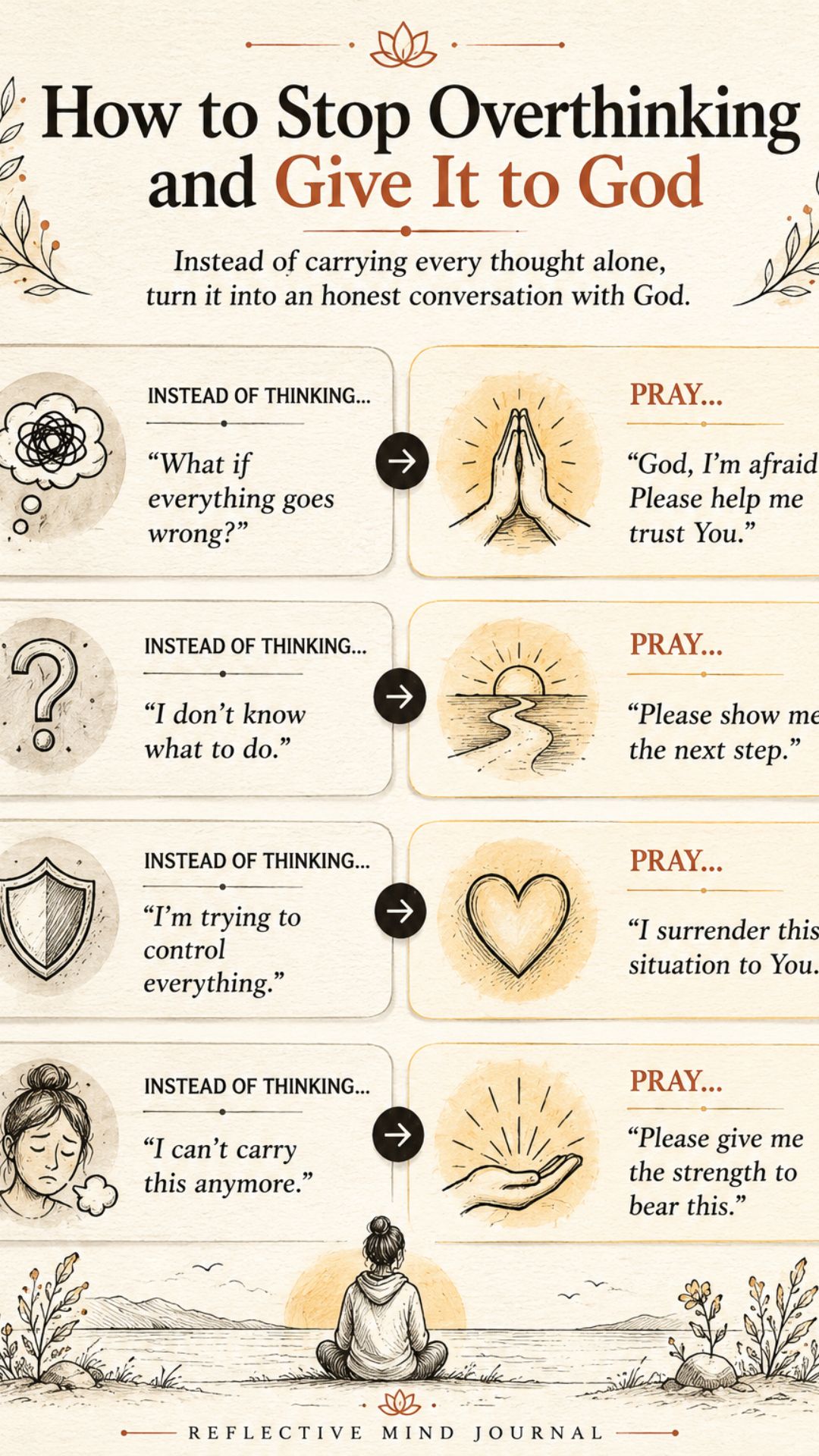
Instead of constantly rehearsing every possible negative outcome, have that conversation with God.
Tell Him honestly about your fears.
Tell Him about your helplessness.
Tell Him about your doubts.
Tell Him exactly what is troubling you.
I often think of Bhagavad Gita 2.7, where Arjuna openly admitted his helplessness before Lord Krishna instead of pretending to be strong.
That verse completely changed the way I look at prayer.
If you’re no longer able to carry something by yourself, tell God exactly that.
Don’t hide it.
Don’t pretend.
Just say,
“God, I can’t handle this anymore. I genuinely need Your help.”
Trust me, with God’s grace, help arrives.
It may not always arrive in the form we expect or at the exact time we want, but in my own life, with Holy Mother’s grace, I have experienced this countless times.
I simply cannot thank God enough for it.
There is another thing I have learnt.
Don’t try to impress God.
Don’t try to sound spiritually perfect.
He already knows everything.
If you’ve made a mistake, tell Him honestly.
If you’re ashamed, tell Him honestly.
If you’re angry, confused, frightened, or disappointed…
Tell Him honestly.
Just like a child runs to his or her parents without pretending to have everything under control, go to God with that same honesty.
Tell Him: “I’m not able to do this anymore.”
“Please help me.”
“Please give me the strength to bear this.”
“Please help me not repeat the same mistake.”
That kind of honest prayer has brought me far more peace than mentally replaying the same fearful conversation a hundred times inside my own head.
Build Trust Through Naam Japa / Mantra Japa Instead of Chasing Mental Certainty
As I mentioned earlier, you simply cannot think yourself into peace.
Real peace gradually comes through the repeated remembrance of God.
Now, I also know from lived experience that when a difficult situation suddenly arrives, you cannot instantly switch off your thoughts and start remembering God with complete concentration.
It doesn’t usually work that way.
So begin with prayer while life is still relatively calm, even if you feel spiritual emptiness at times. When a major crisis suddenly arrives, you may not even have the emotional strength or presence of mind to pray.
Tell God honestly. Pray even when prayer feels empty at times.
“I want to remain peaceful in every situation.”
“I want to remember You constantly because Your remembrance gives me peace.”
“Please help me reach that state through Your grace.”
That honest prayer itself is a beautiful beginning. And you never know, this might help you regain faith in God.
Along with that, I have found Naam Japa / Mantra Japa to be one of the most meaningful spiritual practices for gradually reducing overthinking.
Notice that I said gradually.
If someone has been chanting for five or six hours every day over many years, naturally, that practice will support them differently from someone who has just begun chanting for thirty minutes a day.
That doesn’t mean thirty minutes is ineffective.
Not at all.
Every sincere repetition matters.
What I’m trying to say is that when a crisis suddenly arrives, we usually cannot jump from thirty minutes of daily chanting to eight hours overnight.
Like every spiritual practice, Naam Japa and Mantra Japa deepen gradually through regular practice.
Over time, something beautiful begins to happen.
We human beings cannot live without thoughts.
The mind will keep producing them.
Some will be helpful.
Many won’t.
Instead of allowing those unnecessary thoughts to multiply, Naam Japa gently gives the mind another place to rest.
Whenever a negative thought arises, consciously bring your attention back to the mantra.
Do it gently.
Do it repeatedly.
Even if you have to do this a hundred times in a day, keep returning to it.
Slowly, you may notice that the number of unnecessary negative thoughts begins to reduce.
And during the moments when you’re not consciously repeating the mantra, something surprising often remains.
A quietness.
A sense of inner protection.
A little more space between you and your thoughts.
I’ve experienced this in my own life.
If you’ve been practising Naam Japa throughout the day whenever possible… while cooking, walking, travelling, doing household work, or during small breaks between your daily responsibilities… your mind gradually begins reminding you of the mantra on its own whenever anxiety appears.
And if it doesn’t happen automatically yet, that’s perfectly okay.
Gently bring the mantra back yourself.
Even five minutes of sincere chanting can interrupt a long chain of overthinking.
Over time, this practice doesn’t merely reduce overthinking.
It deepens your relationship with God.
It strengthens your trust in Him.
And slowly, with His grace, you begin to feel as though you’re no longer facing every situation alone.
It’s difficult to explain in words.
I’m not talking about dramatic spiritual experiences or miraculous visions.
I’m talking about a quiet inner feeling that a Higher Power is walking with you… and that changes everything.
Accept That Surrender Feels Uncomfortable Before It Feels Peaceful
All four practices I shared above have genuinely helped me, and I hope you’ll try at least one or two of them. With God’s grace, I’m confident you’ll begin to notice some change… maybe a little more peace, a little more clarity, or simply the feeling that you’re no longer carrying everything by yourself.
But if you ask me what has helped me the most, I would say this:
Learning to surrender everything to God completely.
At the same time, I must honestly admit that surrender is also one of the hardest things to practise.
Why?
Because our faith is usually not deep enough yet.
We say we trust God…
But somewhere deep inside, we still want Him to solve the situation exactly the way we have planned. In other words, we’re surrendering only part of the situation while still trying to control the outcome.
Control feels safer than complete surrender.
But over time, I realised something important.
Control creates exhaustion.
Surrender creates peace.
Think of a small child.
A three or four-year-old child doesn’t worry about paying bills, earning money, arranging food, or planning tomorrow.
The child simply trusts that the parents will take care of everything.
That trust allows the child to live freely.
In many ways, our relationship with God can become like that.
The more we gradually place our lives in His hands, the less exhausted we become trying to carry everything ourselves.
That doesn’t mean fear disappears overnight.
It certainly didn’t in my case.
Even today, I wouldn’t say I’ve completely surrendered to God.
It’s still a learning process.
I’m still learning to surrender every day, not only during difficult situations but also while manifesting with God.
And that’s exactly why I don’t think we should force ourselves to manufacture surrender.
Instead, ask God for it.
Pray honestly.
“God, I want to trust You completely.”
“Please help me develop that trust.”
“Help me surrender this situation to You.”
“Help me believe that whatever You choose will ultimately be for my highest good.”
That has been one of the biggest shifts in my own journey.
I realised that I don’t even have the strength to surrender properly without God’s grace.
So instead of trying to create surrender by force, I simply started asking God to help me surrender. For me, that has been the easiest… and perhaps the laziest… shortcut.
Not because surrender itself is easy.
But because I stopped trying to achieve it entirely by my own effort.
Something else also became clear to me.
Mechanical surrender doesn’t last very long.
You offer a situation to God.
For a few minutes, you feel peaceful.
You remind yourself,
“I’m safe.”
“God is taking care of me.”
And then, before long, you start worrying about exactly the same situation again.
I’ve done that countless times.
Looking back, I realised that wasn’t genuine surrender.
It was only a temporary pause between two rounds of worrying.
When surrender gradually becomes deeper, something changes naturally.
The mind becomes quieter.
The need to control every outcome slowly begins to fade.
You start feeling that you’re being seen…
That you’re being protected…
That Someone wiser than you is carrying what you can no longer carry alone.
I can’t fully explain that feeling in words.
At least I don’t have the capacity to do so yet.
But with God’s grace, I’ve experienced enough of it to know that it is real.
And once you begin experiencing even a little of that inner freedom, overthinking slowly starts losing its hold on your life.
How Do I Completely Trust God to Lead Me? A Quiet Reflection
Trust isn’t built in one prayer or one perfect day.
It grows quietly every time you choose God over fear... every time you stop trying to carry tomorrow before it arrives... and every time you keep doing your duty while leaving the outcome in His hands.
Maybe your mind won’t become completely silent overnight, and you might even feel spiritual loneliness.
But one day, with God’s grace, you’ll realise something beautiful.
The thoughts may still come… they simply no longer have the power to control your peace.
And perhaps that’s where true freedom begins. Not when every question disappears, but when you know you no longer have to find every answer alone.
Frequently Asked Questions
How to stop overthinking and trust God according to Hinduism
If you’re wondering how to stop overthinking and trust God according to Hinduism, begin by remembering that not every thought deserves your attention. The Bhagavad Gita teaches us to do our duty while letting go of the need to control every outcome. Prayer, mantra japa, and surrender gradually calm the restless mind. Trust grows one small step at a time, not all at once.
How to stop overthinking and give it to God?
You don’t have to carry every worry by yourself. Speak honestly to God about what is weighing on your heart, then take the next right step instead of trying to solve every possible future. Surrender is not giving up. It is trusting that God sees what you cannot.
What does God say about overthinking?
While Hindu scriptures do not use the word “overthinking”, they repeatedly remind us not to be ruled by fear, attachment, or anxiety. Trusting God when overthinking according to Bhagavad Gita means learning to focus on your actions while leaving the results in God’s hands. Peace comes when you stop trying to control everything yourself.
What does Lord Krishna say about overthinking?
Although Lord Krishna never speaks about overthinking in modern language, His teachings guide us through it. Trusting God when overthinking by Lord Krishna means steadying the mind, performing your duty, and surrendering the fruits of your actions. The more you remember God, the less power anxious thoughts have over you.
What is the root cause of overthinking?
Overthinking often begins when we feel responsible for controlling everything around us. Fear of failure, uncertainty, and attachment to a particular outcome keep the mind restless. These tendencies are gently replaced with faith, wise action, and surrender to God.
Will God punish me for my thoughts in Hinduism?
No. In Hinduism, passing thoughts are not the same as conscious actions. God understands the struggles of the human mind and invites us to keep turning back to Him with sincerity. What matters is not that difficult thoughts appear, but that we continue walking towards God despite them.
How to stop negative overthinking?
Negative overthinking becomes weaker when you stop feeding every fearful thought. Instead of arguing with your mind, turn your attention towards prayer, mantra japa, or a meaningful task. Trusting God when overthinking in Hinduism is a daily practice of returning to faith whenever fear tries to take over.
How to stop negative overthinking anxiety?
When anxiety fills your mind with endless ‘what ifs’, pause before reacting. Take a few slow breaths, remember God, and focus only on the next step you need to take today. Trusting God when overthinking Hindu teaches us that peace grows when we stop chasing certainty and start relying on God’s guidance.
How to stop overthinking relationships?
Relationships become exhausting when we try to predict every conversation or control every outcome. Do your part with honesty, kindness, and patience, then leave the rest to God. Healthy relationships grow through trust, not constant mental rehearsal.
How to stop overthinking permanently?
Most people do not stop overthinking permanently overnight. The mind learns a new habit through daily prayer, remembrance of God, mantra japa, and steady trust. If you are looking for how to stop overthinking and trust God Hinduism, remember that lasting peace comes from returning to God again and again, even when your mind wanders.






2 Comments