
Why Do I Always Feel Like I’m Too Much for People?
For months, this one liner haunted me — “It’s the same for me, even if you leave or stay…”
I hung up the phone.
In disbelief.
But those words still ring…
Still hurt…
It was a brother, a close friend — or so I thought — who said it at the end of what started as a simple conversation. The words sounded like detachment. But the energy behind them was pure ego wanting to win.
A scar I haven’t been able to plaster yet, and often find myself asking more times than I can count — Why do I always feel like I’m too much for people?
And it wasn’t the first time… where many like him left… I mean the instances may have been different, but the outcome pretty much the same.
For years, I didn’t understand what was happening.
I loved people.
Genuinely. Not the polished, keep-it-light version of love — the real kind.
The kind that remembers what you said three months ago. The kind that shares the actual truth about what’s happening inside, because what else is the point of true friendship?
But… slowly, I noticed.
Some stopped responding.
Some became distant in that particular way where nothing is said directly, but everything shifts.
Some listened to everything I shared — and I later understood they were filing it away. For entertainment. For quiet mockery in rooms I wasn’t in.
That’s when I started editing myself. Pulling back. Performing a coldness I didn’t feel, because the alternative — being fully myself — kept ending the same way.
Maybe you’ve even caught yourself wondering — why do I feel like a burden to everyone — not just to one person, but to the world in general. Like your very presence asks too much of people.
The answer I found wasn’t the one I expected. It didn’t start with me being too much. It started with understanding what actually happens when you carry genuine depth in a world that’s more comfortable with surfaces.
That’s what we’re going to look at.
Why Do I Feel Like Too Much for People — And Why It Won’t Go Away?
Surfaces are comfortable for most. Depth is not.
And if you’ve spent your life loving people from a place of genuine depth — not performance, not strategy, just the way you’re actually wired — you already know this.
Not from theory. From experience.
I have felt this many a time — A conversation where I shared something real and watched the other person’s eyes glaze. A message left on read for days. A friendship that quietly dissolved — no fight, no explanation, just a slow fade that somehow hurt more than any argument could. And each time, the same question. Why do I always feel like a burden to everyone? Not once. Again and again.
To make things worse, when I shared this with someone I would trust with my life, his analogy shocked me. If A, B, and C are having issues with you, that means you’re the problem.
Deep inside, I knew that’s not true… however, when such a remark comes from a place I counted upon, it’s difficult not to make a mark.
And it did.
It’s the same mechanism that makes you feel utterly alone in a crowd — not because no one is there, but because the version of you that’s present feels unseen by all of them.
And guess what? — a mental snowball ensued, the same kind of spiral behind why can’t I stop overthinking.
Maybe I’m feeling like too much for others because I actually am. Maybe I should have been quieter. Smaller. Safer. Maybe I shouldn’t have said that, felt that, needed that.
That’s not a conclusion. That’s a wound talking.
And I almost apologized for existing after that. Because the math looked simple. They left. You stayed the same. So you must be the variable.
And once that equation settles in your mind — it doesn’t leave quietly.
Because every new loss lands on top of everything that came before it.
The first crack becomes the lens — and suddenly every unanswered call, every room that goes quiet when you walk in, every friendship that evaporates without reason becomes proof of the same verdict you’ve been trying to appeal for years.
That’s why it won’t go away. It’s not one feeling. It’s a hundred moments that all point to the same conclusion your mind has already half-accepted.

What Actually Happens When You Love People Who Can’t Hold Depth
But here’s what took me years to see: I wasn’t the problem. And neither were you. We were both just mirrors. And most people have spent a lifetime running from their own reflection.
I was like — I know I’m not reckless with my depth. I don’t pour myself into strangers. I choose carefully, trust slowly, love genuinely. And it still ends the same way.
So the mind does what minds do — it turns inward.
Because here’s what I’ve come to understand — slowly, painfully, and only after losing more people than I care to count. The problem was never the depth. The problem was the mirror.
When you carry genuine warmth, real feeling, love without agenda — you don’t just show up as yourself.
Perhaps people see you as their reflection.
Sometimes they see the version of themselves they buried a long time ago. The softness they decided was weakness. The need for connection, they taught themselves to call neediness. The capacity to feel deeply that the world kept punishing them for. They sealed it off.
And that suppression has its own cost — one reason so many people are burned out without being able to name why. The depth they shut out doesn’t disappear. It drains quietly from the inside.
Many are not even consciously aware that they’re wearing a mask. They see their shadow in you… the version they buried, or at least tried to. It’s that psychological basement where everything many have repressed about themselves, about their lives, unseen, unnamed, but never gone. To fit into the tribe of so-called stronger natives — a world that mistakes numbness for strength.
I‘ve even heard notions like I don’t need people, I’m detached. A truly detached individual would never announce that to the world… furthermore, detachment becomes like his second nature, like breathing. It becomes so ingrained that he doesn’t even realise he is unattached.
And when someone like you walks in. Still feeling. Still open. Still refusing to wear the mask they worked so hard to perfect.
That is unbearable to be near.
So they leave quietly — no argument, no closure, just a version of you they could no longer stand to be near.
Fear of Being Too Needy Spiritually
And I could see this (feel like I’m too much for people) descend to my relationship with the Divine.
It’s a very real feeling for deeply sensitive people. The world rejected their depth. So they turned to the divine. And then quietly wondered if even there, they were asking for too much.
Maybe this is what people mean when they say fear of being too needy spiritually. Perhaps this is also why the wound eventually stops asking, “Why am I too much for people?” and begins asking a different question altogether — is this what spiritual loneliness is?
And yet, Srimad Bhagavad Gita says otherwise.
In chapter 9 verse 22, Sri Krishna tells Arjuna — those who turn to Me with devotion, I personally carry what they lack and preserve what they have. Not sometimes. Always. The Divine, it seems, is the one relationship where needing too much is not only accepted — it is answered.
Why People Don’t Actually See You — They See Themselves
We all carry an image in our heads of how the world works, what to give and expect from others, and how people behave.
Now this picture was built in childhood from our early experiences, our wounds, our rejections… the problem is that such scars don’t dissolve easily, and we tend to bring them along with us (sometimes, without even knowing) to the new people we meet, unknowingly projecting.
We stop seeing the actual person in front of us. We start seeing the character from our past.
Once, a close friend (ex-friend) complimented me on protecting my love and warmth. On the surface, it sounded caring.
But what she was doing was creating a distance inside that praise — and probably doing two things at once without realising it.
She was maybe feeling guilty for the coldness that was already building in her, already planning the exit. And by asking me to guard my loving nature, she was telling me something about herself without knowing it.
If you had similar episodes with someone, you can probably relate. Your openness made them uncomfortable. Not because it was wrong. But because somewhere inside them, they had decided that kind of openness was weak, or unsafe, or something to be managed.
So they didn’t see you. They saw a quality they had suppressed in themselves — and it unsettled them. The immediate response was to project onto you the role of “the vulnerable one.” The one who needs protection. The one who is too open for this world.
And once you are cast in that role in their mind, everything you do is filtered through it. Your genuine care became neediness in their eyes. Your trust became naivety.
Your pain if you had shared something with them during any rough patch of your life became — probably unconsciously — confirmation that they were right to have closed themselves.
They were never really relating to you. They were relating to a character they had created — built from their own fears and their own sealed-off shadow.
Robert Greene writes in The Laws of Human Nature that people rarely relate to you as an individual — they relate to the character they’ve built around you.
My friend wasn’t responding to me, probably.
She was responding to everything I represented in her inner world — the softness she’d buried, the vulnerability she’d decided was dangerous, the mirror I held up without meaning to.
You, the actual person — your history, your specific love, your specific pain — maybe that was never fully seen, acknowledged.
Because they couldn’t afford to.
That feeling of being too much for others? It was never about your excess. It was about their capacity.
And that is the quiet tragedy of it.
Because you gave something real to someone who was only ever engaging with a projection of you.
Not your fault. Not even entirely their fault. Just the tragedy of two people — one still open, one long since closed — meeting at the wrong time.
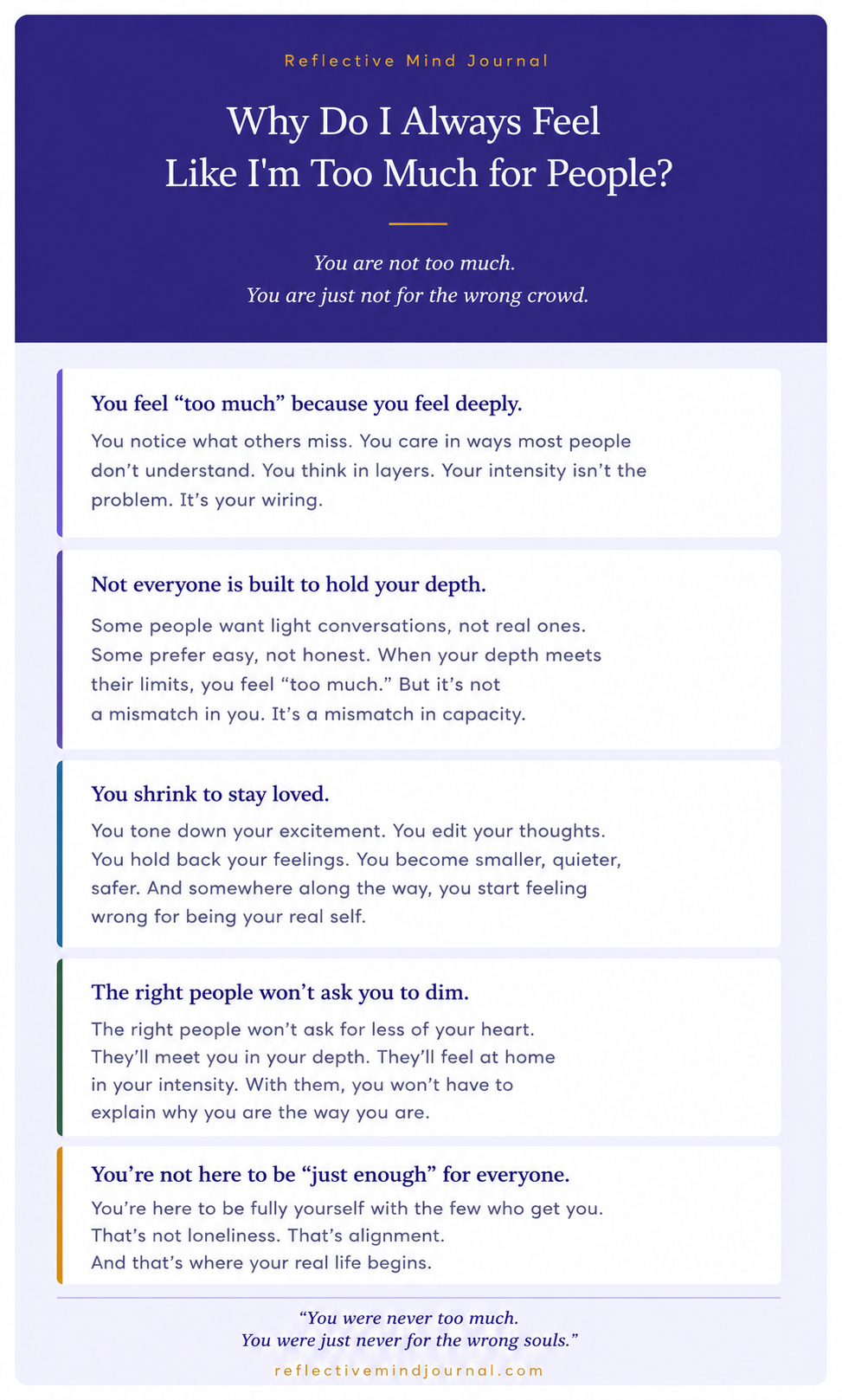
Understanding why this happened can bring relief.
Understanding why this happened can bring relief. But understanding alone doesn’t always heal a wound we’ve carried for years. At some point, the question gently changes from, “Why did this happen to me?” to, “Where do I go from here?”
Perhaps that’s where healing truly begins.
What to Do If You Feel Like You’re Too Much for People
If you’ve reached this point in the article, perhaps one question is quietly sitting in your heart:
“I understand why this happens… but what do I actually do now?”
There is no overnight cure for a wound you’ve carried for years. But there are gentle steps that can begin changing the way you relate to it.
Step 1: Notice the story you’ve started believing
Before asking why someone left or why someone misunderstood you, ask yourself a quieter question:
“What did I begin believing about myself because they left?”
Perhaps somewhere along the way, the story became:
- “I feel like I’m too much for people.”
- “I overwhelm everyone.”
- “People eventually get tired of me.”
- “Maybe I really am the problem.”
Don’t argue with those thoughts.
Don’t analyse where they came from.
Just notice them… the same quiet practice behind how to stop overthinking and trust God.
Very often, we spend years fighting the feeling without ever seeing the story underneath it.
And hidden stories cannot heal while they remain hidden.
Healing often begins the moment the wound is finally brought into the light.
Step 2: Name the wound instead of becoming the wound
There is a quiet but life-changing difference between saying,
“I feel like I’m too much for people.”
and saying,
“I am too much for people.”
The first sentence describes an experience.
The second creates an identity.
Most of us don’t even realise when that shift happens.
A painful experience slowly becomes a permanent definition.
Today, simply name what hurts without allowing it to become who you are.
You may feel like you’re too much for people.
That doesn’t mean you are.
Step 3: Surrender the identity, not just the pain
This is perhaps the hardest step.
Many of us bring our pain to God.
Very few of us bring the identities our pain created.
In Bhagavad Gita 2.7, Arjuna doesn’t stand before Sri Krishna pretending he already understands himself. He admits his confusion completely and asks to be guided.
Perhaps this is your moment to do the same.
Instead of trying to convince yourself that you’re “not too much,” bring the belief itself before God.
You can pray as simply as this:
“Lord, I no longer know whether this identity I’ve carried for years is true. If this belief came from my wounds rather than from You, help me let it go.
Show me who I am through Your eyes, not through every rejection I’ve carried.”
Step 4: Let one conversation become an experiment
The next time you speak with someone you trust, notice what happens before you even begin speaking.
Ask yourself:
- Am I apologising for my feelings before I’ve even expressed them?
- Am I shortening my thoughts because I’m afraid I’ll be “too much”?
- Am I hiding my warmth because someone once made me feel foolish for caring?
- Am I editing myself before anyone has actually rejected me?
Then try one small experiment.
Speak honestly.
Not excessively.
Just honestly.
And then let the other person respond before deciding what they think of you.
You may discover something surprising.
Much of the fear wasn’t coming from the present conversation. It was coming from an old wound that had quietly started speaking on behalf of every new relationship.
You don’t have to keep letting yesterday introduce you to today’s people.
If You Feel Like You’re Too Much for People, Ask Yourself This One Question
One of the quietest consequences of feeling like you’re too much for people is that, after hearing it enough times, you begin believing it yourself.
Perhaps nobody has called you “too much” in years.
But the voice stayed.
Now it speaks from inside your own mind.
It tells you not to care too deeply.
Not to message first.
Not to be excited.
Not to need.
Not to cry too openly.
Not because any of these things are wrong.
But because somewhere along the way, you borrowed someone else’s opinion and slowly mistook it for your own.
If enough people misunderstand us, their voices can become louder than our own. Little by little, we stop asking, “Is this true?” and start living as though it is.
And perhaps that is the deepest wound of all.
Not that people failed to see you.
But that you slowly stopped seeing yourself.
So before asking again,
“Why do I always feel like I’m too much for people?”
Ask yourself a different question. A quieter one.
Whose eyes have I been seeing myself through all these years?
Have I been seeing myself through God’s eyes…
Or through the eyes of every person who misunderstood me?
Through the eyes of people who couldn’t receive my honesty.
People who were uncomfortable with my love.
People who mistook openness for weakness.
People who projected their own fears onto me.
If ten people misunderstood you, it doesn’t automatically make their version of you true.
It only means ten people saw you through the limits of their own capacity.
But if you’ve carried those voices for years, it’s understandable that they’ve begun sounding like your own.
Perhaps that is what needs to be surrendered to God completely.
Not your sensitivity.
Not your capacity to love.
Not your depth.
The identity that grew around your wounds.
The version of yourself built from rejection rather than truth.
You might pray as simply as this:
“Lord, somewhere along the way, I forgot how to see myself. I’ve been carrying names that other people gave me, and I’ve worn them for so long that I no longer know which ones are mine. Help me lay them down. Help me see myself as You see me.”
You don’t have to answer that prayer in a single day.
Sometimes healing begins simply by becoming aware that you’ve been looking into the wrong mirror.
And perhaps that is where surrender begins, too.
Sometimes, surrender isn’t about surrendering your future. Sometimes it’s surrendering the identity your wounds convinced you was true.
You Were Never Too Much. You Were Just Too Real.
And yet — knowing all of this doesn’t make the ache disappear overnight.
Because you gave something real. And that deserves to be acknowledged before anything else.
Why do I always feel like I’m too much for people — that question lived in me for years. And the answer, when it finally came, wasn’t what I expected.
You were never too much. You were just too real for people who had already made peace with being less.
You weren’t the problem.
You were just too honest for a world still practicing its performance.
And perhaps, little by little, you can stop seeing yourself through that world’s eyes… and begin seeing yourself through God’s.
Keep going.
Frequently Asked Questions
FAQ 1: Why do I feel like a burden to everyone, even when I haven’t done anything wrong?
Because the feeling rarely comes from what you’ve done — it comes from a pattern of giving your depth to people who were only equipped for surfaces. Every loss added weight to a verdict your mind started accepting as fact. It was never the truth. It was accumulated pain wearing the mask of self-awareness.
FAQ 2: Why do I always feel like I’m too much for people, no matter how much I hold back?
Holding back doesn’t fix the root feeling — it just adds a new layer of loneliness on top of it. The people who found you too much weren’t reacting to your actual self. They were reacting to what your openness reflected back at them. No amount of shrinking yourself fixes someone else’s discomfort with their own reflection.
FAQ 3: Is feeling like too much for others a sign something is wrong with me?
No. It’s usually a sign that you carry a depth most people were never taught to hold — not in themselves, and not in others. The world is more comfortable with people who have learned to need less, feel less, and ask less. That comfort is not a standard. It’s just a habit most people never thought to question.






One Comment