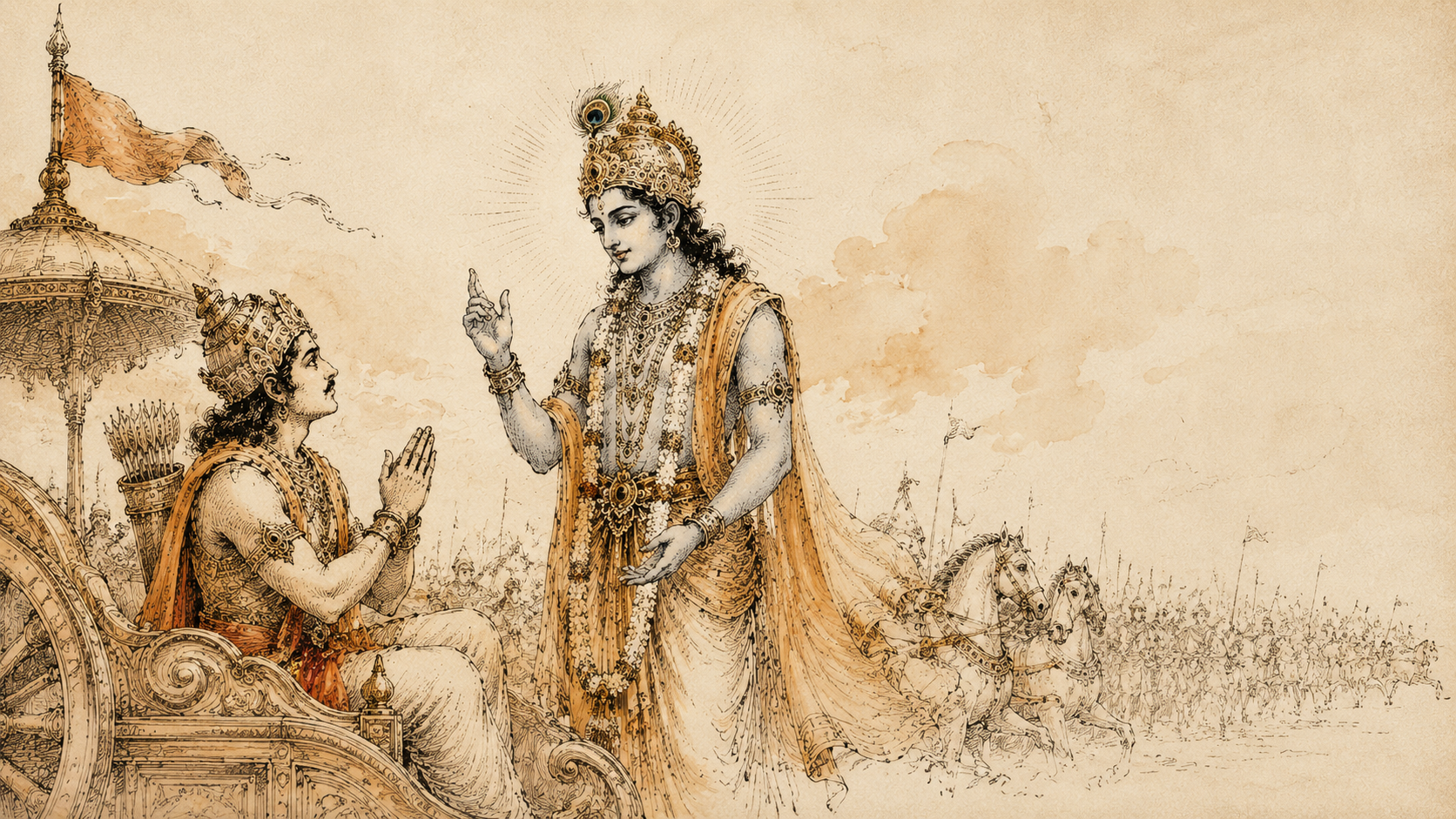
How to Surrender to God Completely: Bhagavad Gita 9.34 Explains It in 4 Steps
If you’re struggling with how to surrender to God completely, Bhagavad Gita verse 9.34 offers one of the clearest answers.
“Fill thy mind with Me, be My devotee, sacrifice unto Me, bow down to Me; thus having made your heart steadfast in Me, taking Me as the supreme Goal, you shall come to Me.” — Sri Krishna
Verse 9.34 – Translation by Swami Ranganathananda (Universal Message of the Bhagavad Gita)
This verse beautifully breaks surrender into four clear steps that God Himself gives us. Rather than leaving surrender as an abstract spiritual idea, Sri Krishna provides a complete roadmap for how we can gradually surrender to Him. These are not merely suggestions. Because they come directly from God, they are the truth and carry His assurance.
At the same time, you may already know these teachings and even be trying to practise them, yet honestly feel that you haven’t been able to live all four steps completely. That’s okay.
Don’t give up.
That does not make Sri Krishna’s directions in Bhagavad Gita surrender to God, any less true. It simply means we are all somewhere along the journey of learning to surrender.
We often feel a gap between ourselves and God, and faith feels mechanical. Even so, we can always make an honest effort to move closer to Him.
In this article, you’ll discover four practical steps on how to surrender to God completely, based on Bhagavad Gita 9.34, along with lived examples and practical takeaways for real-life application.
How to Surrender to God Completely – 4 Powerful Ways
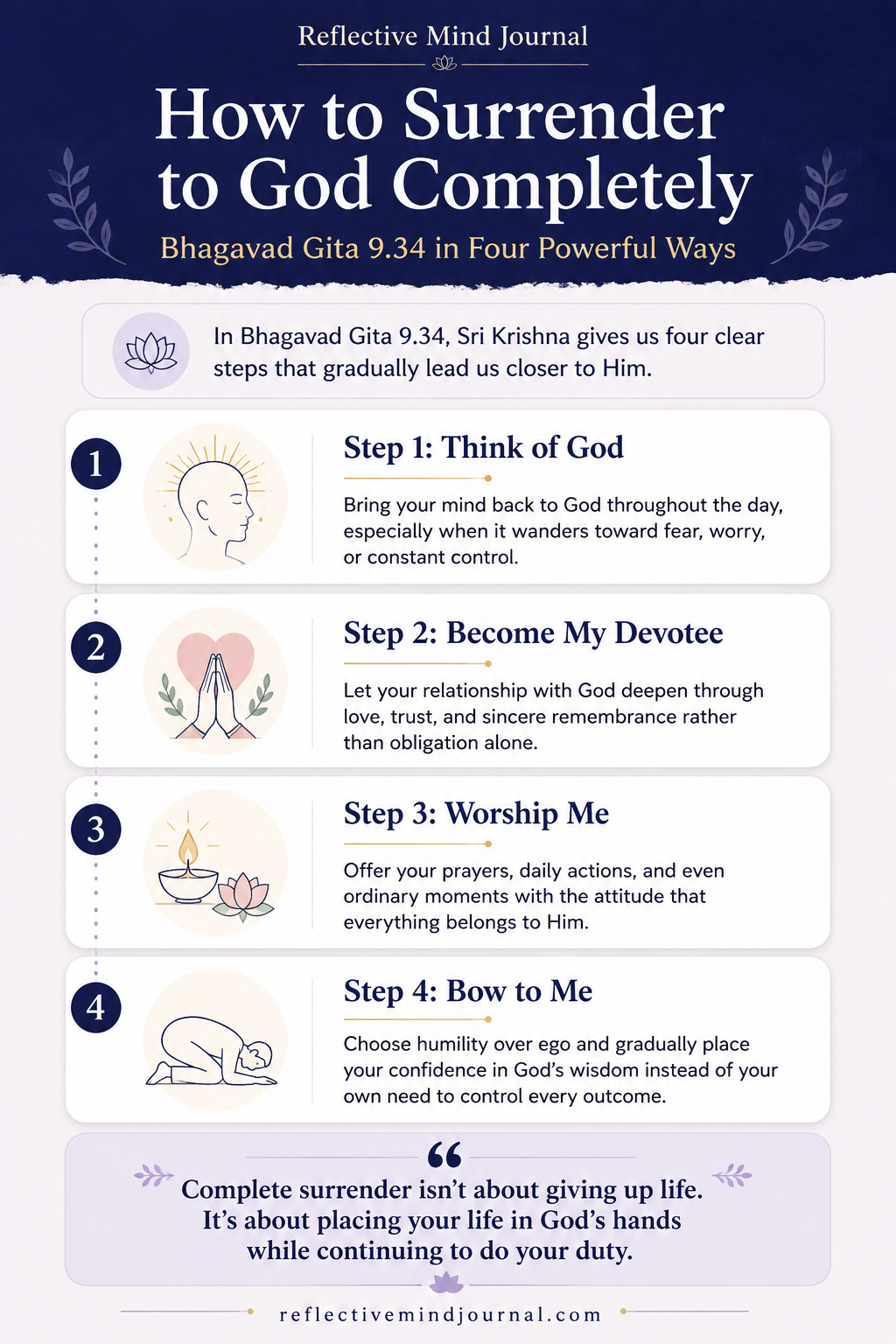
Here are the four practical steps on how to surrender to God completely, as taught by Sri Krishna in Bhagavad Gita 9.34.
Step 1: Think of God
- Lord Krishna’s first instruction on how to surrender to God completely, per Bhagavad Gita, is simple: “Think of Me.”
- This is surrender at the level of the mind and our thoughts.
- As the saying goes, what you think about, you become. The direction of our thoughts gradually shapes the direction of our lives.
- Therefore, we should consciously centre our thoughts on God and allow our minds to gravitate towards Him throughout the day.
- The mind’s natural tendency is to wander.
- Whenever we notice it has drifted away, we should gently bring it back to God instead of becoming discouraged.
- This repeated practice slowly begins the inner transformation.
Step 2: Become My Devotee
- Lord Krishna’s second instruction in the Bhagavad Gita surrender to God, is: “Become My devotee.”
- This is surrender at the level of the heart and our feelings.
- As more of our thoughts become centred on God, we begin to notice a gradual inner shift.
- Over time, our relationship with God starts becoming stronger and more personal.
- We begin to experience a deeper love and devotion towards Him instead of merely thinking about Him.
- In many ways, this second step is a natural progression from the first. When the mind repeatedly turns towards God, the heart slowly follows.
Step 3: Worship Me
- Lord Sri Krishna’s third instruction is: “Worship Me.”
- Worship is not limited to formal rituals or daily prayers, although those are also important.
- There is a deeper level of worship where every action becomes an offering to God.
- Take the simple, everyday moments of life, for instance. Whether you are washing dishes, cooking, taking a walk, or simply sipping a cup of tea, you can consciously offer that action to God.
- The same applies to the bigger areas of life. Whether you are working on your dream project, building a business, pursuing a career, or striving towards any meaningful goal, perform every action with sincerity and then offer the results to God.
- When every action becomes an offering, worship is no longer confined to a particular time of the day. It becomes a way of living.
Step 4: Bow to Me
- Lord Krishna’s fourth instruction is: “Bow to Me.”
- This is how to surrender to God completely at the level of the ego.
- Bowing to God begins with remembering that there is a power infinitely greater than ourselves.
- When we genuinely recognise and honour that higher power, the dissolution of the ego begins through God’s grace.
- Bowing to God is more about thinking less from the ego and remembering that every ability, every opportunity and every blessing ultimately comes from Him.
- The more we stop believing that we alone are the doer, the more we make space for God’s guidance to work through our lives. That shift from “I am doing everything” to “God is working through me” is where surrender begins to deepen.
- As the ego gradually dissolves, we become more open to witnessing God’s grace and the miracles that unfold in our lives.
- Lord Sri Krishna’s words in Bhagavad Gita 9.34 are not wishful thinking or uncertain advice. They are God’s assurance that these steps lead us towards Him.
- When our thoughts, feelings, actions, and ego are all offered to God—to Bhagwan, to the Divine Mother—we move towards complete surrender.
- With God’s grace, this surrender gradually prepares us for spiritual union with Him.
Short on Time? Read This First
All in all, your thoughts shape your reality.
Sri Krishna begins with the mind because everything else flows from there. Thoughts influence your feelings, your feelings shape your actions, and your actions gradually transform your life. That is why the journey of how to surrender to God completely begins at the level of thought.
So begin today by gently bringing your thoughts back to God. That way, perhaps the spiritual emptiness and spiritual loneliness that you encounter may also lessen.
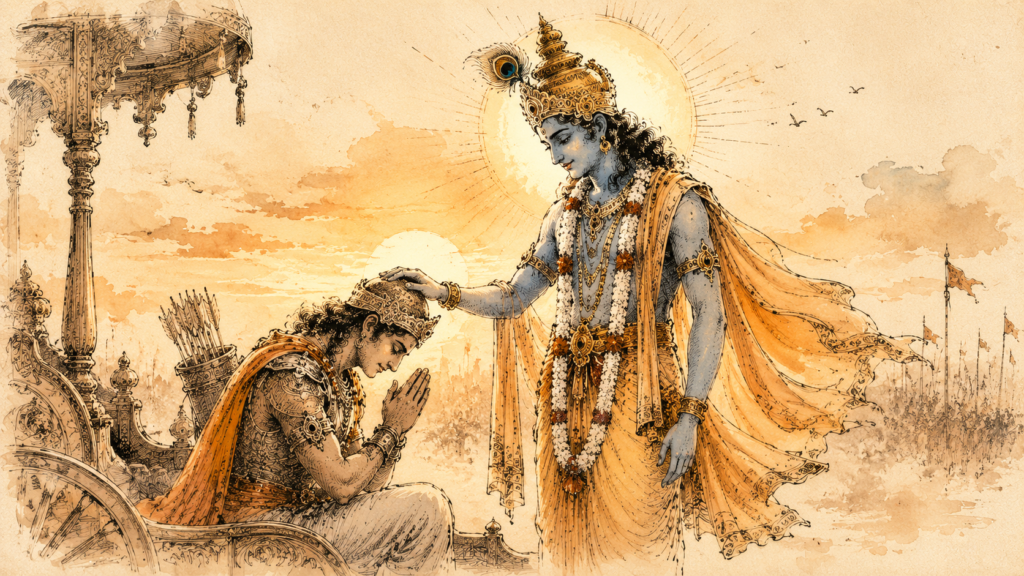
What Others May Not Say About How to Surrender to God Completely – Daily
Surrendering to Krishna daily sounds simple when we read or hear about it. But in reality, these steps can feel mechanical at first, especially if you’re already wondering whether faith can be regained if lost.
At the end of the day, it’s deep faith that holds all these steps together and makes surrender come alive. The challenge is that neither genuine surrender nor deep faith can be manufactured. Both require God’s grace, and you never know when that grace will unfold. It does not arrive on a fixed date or follow a specific timeline.
The same principle also applies if you’re actively trying to manifest with God.
What you can do is pray sincerely for more grace, allowing your surrender to become deeper, more effortless, and more genuine. Learning how to stop overthinking and trust God can gradually help you loosen that grip and return your attention to Him.
I feel that deep faith and surrender complement each other. As one grows, the other naturally becomes stronger. It is a sweet paradox that unfolds through immense patience and God’s grace.
For example, imagine you are praying to God for your dream job. You sincerely desire it, but despite your prayers, you don’t receive that particular opportunity.
Even then, you remain at peace because you have the deep conviction that everything will ultimately work out for your highest good. If God did not give you that job, you trust that He has planned something better for you.
That is the kind of simple yet profound faith we all aspire to cultivate. It is as natural and unquestioning as knowing that tomorrow morning you will wake up, prepare your cup of tea, or have your breakfast. There is no anxiety or doubt about it.
In the same way, with God’s grace, we gradually develop that quiet certainty that He is making a way for us, even when we cannot yet see it. But that kind of faith is very difficult to manufacture on our own.
The same happens with surrender. We tell God, “I have surrendered this problem to You. Please take care of it and everything related to my life.”
Yet only a few hours later, we are checking our phones again and again.
Did the email arrive? Did they accept my application? Did the pending payment arrive? Did my business idea work? Am I getting customers? Am I getting clients?
When we are desperately searching for immediate signs that everything is working out, it often shows that we are still holding on internally.
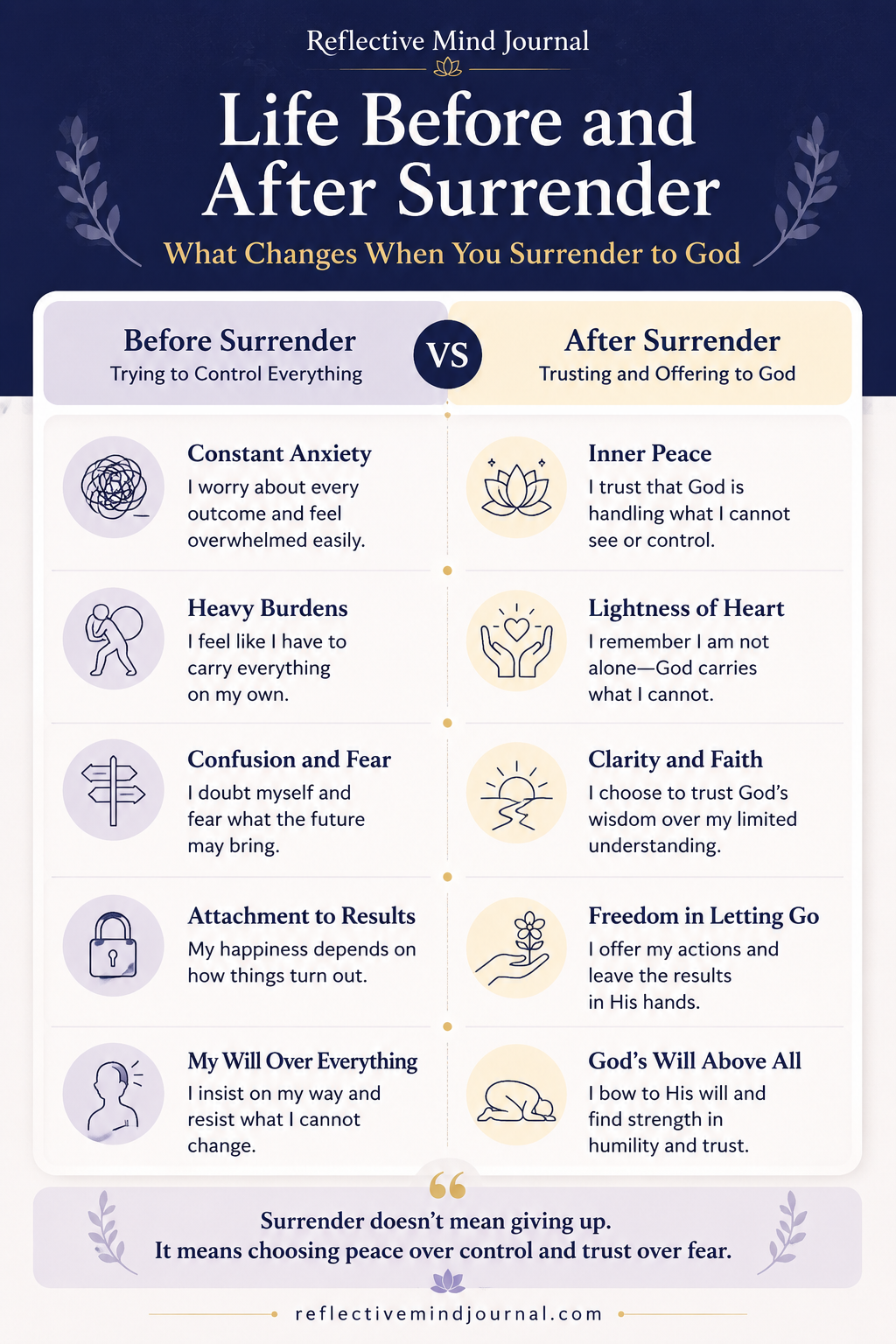
Genuine surrender is not pretending that we have let go. It is gradually reaching a place where our trust in God becomes stronger than our urge to constantly control the outcome.
Practical Takeaways on How to Surrender to God Completely – Daily (With Real-Life Examples)
These four steps on how to surrender to Krishna completely may look simple when we read them, but living them every day is an entirely different journey.
If you are wondering where to begin, start with the first step: “Think of Me.” Everything else slowly grows from there.
This is also a learning journey for me. I am simply sharing what I practise, hoping it may help you in your own journey.
For instance, in the morning, I find it much easier to think about God. Everything is quiet and peaceful. I spend time in mantra japa, praying even if it feels empty on certain days, chanting a stotram, and reading a little scripture. Naturally, my mind stays centred on Him.
But once work begins or life becomes busy, I sometimes realise that I have spent hours completely absorbed in my responsibilities and have forgotten God. This has happened to me many times, and it may happen to you as well.
Whenever that happens, I simply speak to God honestly. I tell Him, “I was sincerely engaged in my work and couldn’t think of You. Please forgive me.” Then I offer those hours of work back to Him. In doing so, my work itself becomes an offering. Without consciously planning it, I realise that I have also begun practising the third instruction: “Worship Me.”
This simple practice helps me return to God again and again throughout the day instead of feeling guilty for forgetting Him. You can try it too.
Slowly, with God’s grace, thinking about Him becomes less forced and more natural.
As more of our thoughts remain centred on God, something quietly begins to change within us. The heart follows where the mind repeatedly goes. Love begins to grow naturally, not because we try to manufacture it, but because we stay close to Him.
And as that love deepens, bowing to God also begins to happen more sincerely. We gradually stop feeling that we alone are carrying our lives. We become more willing to trust His wisdom over our own. In this way, the second and fourth steps also begin to unfold naturally through His grace.
I am not saying I have reached the stage of complete surrender to God.
But I do believe Sri Krishna’s words cannot be untrue. If we sincerely practise what He has asked of us, an inner transformation slowly begins. It cannot always be explained, but it can certainly be experienced.
Pro-Tip: A Small Prayer for How to Surrender to God Completely
If today you feel that you are unable to surrender, let that become your prayer. Even one of the mightiest warriors, Arjuna, did the same by admitting his confusion and helplessness before Sri Krishna, as we see in Bhagavad Gita 2.7.
Tell God honestly,
“Lord, I want to surrender. I am also aware of some of Your teachings, but I still find them difficult to practise. Please teach me… or rather, please get them done through me.”
True surrender brings deep peace. We reach it through sincere effort, but above all, through God’s grace.
And perhaps the most comforting thought of all is this:
Even the desire to surrender to God, and every small effort you make towards Him, is itself His grace already working within you.
———————-
Frequently Asked Questions
How to surrender to God completely Hindu?
Learning how to surrender to God completely Hindu is not about giving up your responsibilities or becoming passive. In Hinduism, surrender means offering your thoughts, actions, and their results to God while continuing to perform your duties sincerely. The Bhagavad Gita teaches that surrender grows through steady devotion, trust, prayer, and remembrance rather than through one dramatic moment. Over time, this attitude brings greater peace because you begin relying more on God’s wisdom than on your own constant need for control.
How to surrender to God according to the Bhagavad Gita?
If you’re wondering how to surrender to God according to the Bhagavad Gita, Chapter 9, Verse 34 offers a simple yet profound direction. Sri Krishna asks us to keep our mind on Him, cultivate devotion, worship Him, and bow before Him with sincerity. Bhagavad Gita 9.34 shows that surrender is built through a daily relationship with God, not merely through emotion. It is less about trying to control every outcome and more about gradually placing your heart where your trust belongs.
What does Sri Krishna say about surrender?
When people ask, What does Sri Krishna say about surrender?, the Bhagavad Gita consistently points toward wholehearted devotion and trust. In Bhagavad Gita 9.34, Sri Krishna invites us to remember Him, love Him, and dedicate ourselves to Him with sincerity. His teaching is not based on fear but on relationship. True surrender to God begins when devotion becomes more important than the constant need to control life.
How do I know if I surrendered to God?
One sign that you have begun to surrender to God is not that every problem disappears, but that your inner response slowly changes. You may still experience uncertainty, yet you find yourself returning to prayer instead of panic and trust instead of constant fear. You become less attached to controlling every result and more willing to accept God’s timing. Surrender is often recognised through growing peace, humility, and steadiness rather than dramatic spiritual experiences.
How do I truly surrender to God?
Many people ask how to surrender to God, but true surrender usually develops little by little. It begins with honest prayer, remembering God throughout the day, and offering your work without becoming consumed by the outcome. Practices such as japa, reading the Bhagavad Gita, and quiet self-reflection can gently strengthen this attitude over time. Rather than forcing surrender, keep choosing trust whenever the mind wants to cling to control.
What happens after surrendering to God?
After surrendering to God, life may not suddenly become free of challenges, but your relationship with those challenges often changes. You gradually stop measuring God’s presence only by favourable circumstances and begin trusting Him even during quieter seasons. This deeper trust can bring greater emotional stability, patience, and hope. In many ways, surrender changes the heart before it changes the situation.






4 Comments