
Bhagavad Gita on Overthinking: 5 Verses and How to Apply Them
You can know that something is no longer in your hands and still find your mind asking, “But what will happen?”
You may have prayed about it, tried to do what you could, and even told yourself to leave the rest to God… yet, after some time, the same thought quietly returns, and you are just not able to stop overthinking.
I have noticed this in my own life too. With God’s grace, I have become less trapped in thoughts about the past, but worrying about the future can still overwhelm me at times and leave me feeling helpless.
This is where the Bhagavad Gita on overthinking becomes meaningful to me. The Gita does not use the modern word “overthinking”, but Krishna speaks deeply about the restless mind, attachment to results, emotional disturbances, and our difficulty in accepting what we cannot control. These teachings can feel surprisingly close to everyday life when you are waiting for an answer, worrying about work, relationships, finances, or simply wondering what lies ahead.
The Bhagavad Gita verses on overthinking do not offer a way to make every uncertain thought disappear. Instead, they show you how to relate to those thoughts differently.
If you are struggling with overthinking, these teachings can help you return to what is in your hands, steady the wandering mind, and slowly learn to let go of what is not.
5 Bhagavad Gita Verses on Overthinking
When the mind keeps asking for an answer that life has not given you yet, thinking can quickly turn into overthinking. The Bhagavad Gita on overthinking offers something more useful than simply telling us to “stop worrying”. Its teachings help us see where the mind gets stuck and where we can bring our attention back.
The following Bhagavad Gita verses on overthinking address five different struggles that can keep the mind caught in the same loop.
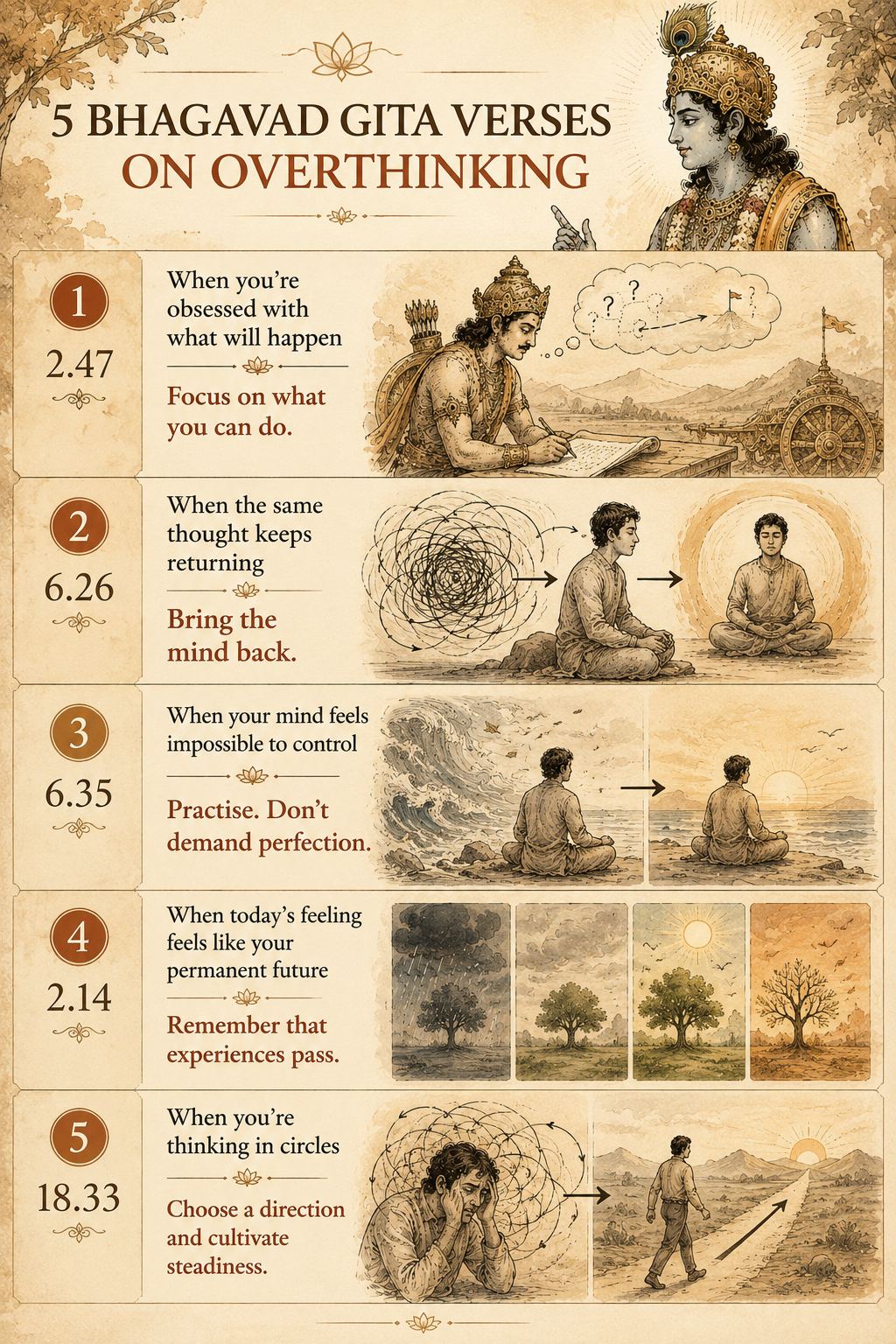
1. Bhagavad Gita 2.47: Focus on What Is in Your Hands
“Your right is to work only; but never to the fruits thereof. May you not be motivated by the fruits of actions; nor let your attachment be towards inaction.” – Bhagavad Gita 2.47
Universal Message of the Bhagavad Gita by Swami Ranganathananda
This is one of the most relevant Bhagavad Gita quotes on overthinking when your mind is constantly trying to predict what will happen next. Krishna is not asking Arjuna to stop caring about the result. He is asking him to recognise the difference between doing his part and trying to control what comes from it.
That distinction matters in everyday life. You may be working towards something important and keep wondering whether it will succeed. You may have sent a message and keep checking your phone. You may have made an effort at work, in a relationship, or towards a personal goal, and still find yourself asking whether it will lead to the outcome you want. I have experienced this kind of future-focused overthinking myself. Even after doing what I can, the mind can still demand certainty about what comes next.
The Bhagavad Gita on how to stop overthinking begins here: bring your attention back to the part that is actually yours. You can choose the effort, the next step, and the way you respond. You cannot mentally rehearse an outcome into existence.
This is also where the Bhagavad Gita on how to stop overthinking and trust the process becomes practical. Trust does not mean sitting back and doing nothing. It means doing what is yours to do without making your peace completely dependent on knowing how everything will turn out.
Practical takeaway: When you notice yourself repeatedly asking, “What will happen?”, ask instead, “What is in my hands right now?” Then return to that.
2. Bhagavad Gita 6.26: Bring the Mind Back When It Wanders
“Through whatever reason the restless, unsteady mind wanders away, let one, curbing it from that, bring it under the subjugation of the Self alone.” – Bhagavad Gita 6.26
Universal Message of the Bhagavad Gita by Swami Ranganathananda
This is one of the most direct teachings in the Bhagavad Gita on overthinking because Krishna does not assume that the mind will simply stay where we want it to. He acknowledges that it wanders. The important part is what we do when it wanders.
Think about what happens when you are worried about something. You may tell yourself, “I won’t think about this anymore.” For a while, you manage to focus on something else. Then the same thought comes back. You start analysing it again, imagine another possibility, remember something you had forgotten, and before you realise it, you are back in the same mental loop.
The Bhagavad Gita on how to stop overthinking is not asking you to win an argument with every thought. It gives you a simpler direction: bring the mind back. If your mind has gone ten times, you bring it back ten times. The return itself is the practice.
This can be especially helpful when the thought is about something you cannot resolve immediately. You do not have to find an answer every time your mind brings up a question. Sometimes the next step is simply noticing, “I am thinking about this again,” and gently moving your attention elsewhere.
This is also why the Bhagavad Gita verses on overthinking are more than philosophical ideas. They give us a different understanding of progress. You are not failing because the thought returned. You are practising each time you choose not to follow it further.
Practical takeaway: When you notice the same worry returning, don’t fight it or start analysing it again. Simply notice it and bring your attention back to what you were doing. The more often you practise returning, the less power the mental loop can have over you.
3. Bhagavad Gita 6.35: A Restless Mind Can Be Trained
“Without doubt, O mighty-armed, the mind is restless and difficult to control; but through practice and renunciation, O son of Kunti, it can be achieved.” – Bhagavad Gita 6.35
Universal Message of the Bhagavad Gita by Swami Ranganathananda
Arjuna admits to Krishna that controlling the mind is extremely difficult. Krishna does not deny this. He acknowledges its restless nature, but also makes it clear that the mind can be trained through practice and detachment.
This matters when you are exhausted by your own overthinking. You may understand perfectly well that worrying about tomorrow will not change tomorrow, yet the same worry can return again and again. Then another thought appears: “Why can’t I control my own mind?” That frustration can become another layer of suffering.
The Bhagavad Gita on overthinking reminds us that understanding something once is not the same as practising it. A restless mind needs repeated training. Detachment matters too, because sometimes we keep thinking because we desperately want certainty. We want to know how everything will turn out before we allow ourselves to feel at peace.
This is why the Bhagavad Gita on how to stop overthinking does not promise instant control. It asks for practice. You may have to work with the same worry many times before your response to it begins to change.
Practical takeaway: Don’t expect yourself to stop overthinking overnight. Each time you catch yourself adding another “what if” to the same worry, stop there. You don’t need to solve the thought again. That small pause is part of training the mind.
4. Bhagavad Gita 2.14: Not Every Difficult Feeling Needs an Immediate Answer
“O son of Kunti, the contact between the senses and the sense objects gives rise to fleeting perceptions of happiness and distress. These are non-permanent, and come and go like the winter and summer seasons. O descendant of Bharat, one must learn to tolerate them without being disturbed.” – Bhagavad Gita 2.14
Bhagavad Gita The Song of God by Swami Mukundananda
When you are overthinking, a difficult feeling can make a situation appear much more permanent than it really is. Anxiety arrives, and the mind immediately starts asking, “What if this continues? What if things never get better?” But Krishna reminds Arjuna that many experiences have a beginning and an end.
This does not mean that your pain is imaginary or that you should simply ignore it. It means you don’t have to make a decision about your entire future from the middle of one difficult emotional moment. You can feel worried today without deciding that everything will go wrong.
This is an important part of the Bhagavad Gita on overthinking. Sometimes we keep analysing a situation because we want to get rid of the uncomfortable feeling it has created. But not every feeling needs to be solved immediately. Some feelings need to be experienced, allowed to pass, and seen with a little more distance.
This is also a quieter way of understanding the Bhagavad Gita on how to stop overthinking and trust the process. Trust does not mean pretending that everything feels good. It means not allowing a temporary emotional state to convince you that you already know how the whole story will end.
Practical takeaway: When a strong feeling makes you want to analyse your entire life, don’t make the feeling your fortune teller. Give yourself time before deciding what the feeling means about your future.
5. Bhagavad Gita 18.33: Develop Steadiness Instead of Thinking in Circles
“The fortitude by which the functions of the mind, the prāna, and the senses, O Partha, are regulated, that fortitude, unswerving through yoga, is sāttvika.” – Bhagavad Gita 18.33
Universal Message of the Bhagavad Gita by Swami Ranganathananda
This verse gives another perspective on the Bhagavad Gita on overthinking. Sometimes the problem is not that we have too many thoughts, but that our attention keeps getting pulled in different directions. We think about one possibility, then another, then imagine what someone might say, then question the decision we had almost made.
You may have noticed this when facing an important choice. You can spend so much time examining every possible outcome that the search for the “right” answer becomes more exhausting than the decision itself. I have experienced this kind of overthinking around major decisions too. At some point, thinking harder does not necessarily give you more clarity.
The teaching here is about steadiness.
The Bhagavad Gita verses on overthinking are not asking us to analyse every possibility until we feel completely certain. Sometimes clarity comes from gathering what you know, choosing a direction, and having enough determination to stay with it instead of reopening the same question every few hours.
This also adds another dimension to the Bhagavad Gita on how to stop overthinking. A steady mind is not a mind that never has doubts. It is a mind that does not allow every new doubt to pull it away from the direction it has consciously chosen.
Practical takeaway: When you have already thought through a decision honestly, stop putting the same decision back on trial every day. Give yourself permission to stand by a considered choice unless genuinely new information changes the situation.
How to Stop Overthinking at Night
Sometimes, knowing the teachings is not enough.
I have had nights when I was lying awake, staring at the ceiling, already knowing that I was overthinking and knowing that I could not solve the situation at that hour… and still, I could not make my mind stop. I would look at my phone and realise it was 1 a.m. Then somehow 2 a.m. had arrived.
The same thought was still there, and with every passing hour came another worry: “Will I be able to sleep? What if this does not get better?” In those moments, even whatever little I knew about scripture, surrender, and the Bhagavad Gita on overthinking seemed difficult to remember. I simply felt overwhelmed and helpless.
That is why I don’t want to give you another long list of things to remember when you are trying to figure out how to stop overthinking at night. I want to give you one simple practice.
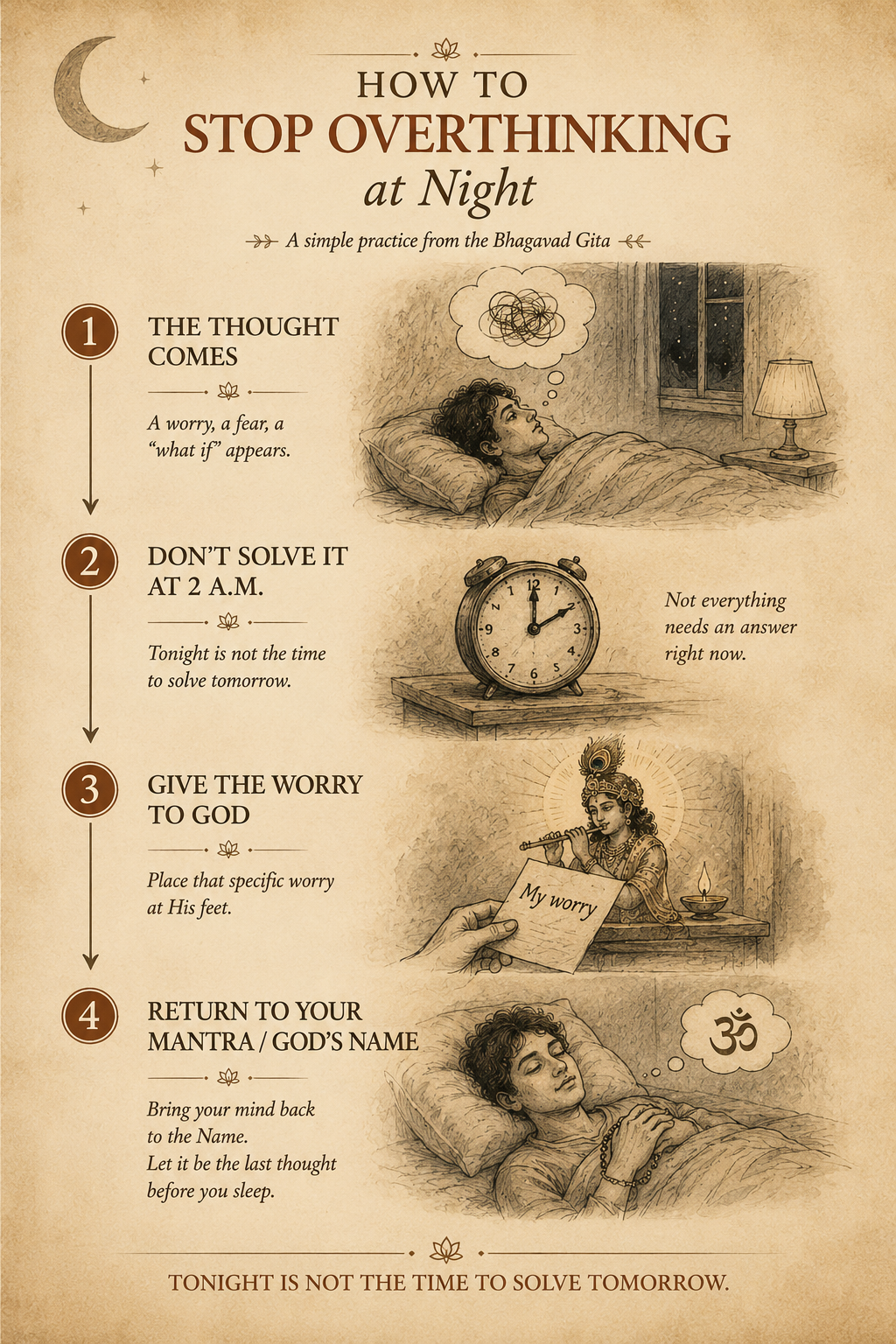
When the worry comes, give that specific worry to God instead of trying to solve it in bed.
You can say something as simple as this prayer for overthinking:
“Mother, I don’t know what will happen. I have done what I can for today. I cannot solve this tonight, so I am leaving it with You. Please take care of what I cannot.”
It isn’t so different from Arjuna’s own honest prayer in Bhagavad Gita 2.7, admitting confusion instead of pretending to have it figured out.
Then repeat your mantra by counting on your fingers, or simply say God’s name quietly as advised by your Guru, and return to it whenever the same thought comes back.
Don’t expect yourself to surrender once and never think about the worry again. The mind may pick it up five times, ten times, or more. Each time, give it back. You don’t need a new argument with your mind every time the thought returns.
This is one practical way to apply the Bhagavad Gita on overthinking when the mind is most vulnerable to spiralling. You are not trying to make the future certain before you sleep. You are simply deciding that tonight is not the time to solve tomorrow.
And if the thought returns, give it back again. Sometimes, that is the practice.
What the Bhagavad Gita Says About Letting Go
Perhaps the hardest part of overthinking is accepting that some things will remain uncertain no matter how much you think about them. You can do your part, pray sincerely, and still find yourself asking, “But what if it doesn’t happen?” This is where surrender becomes different from simply telling yourself to stop worrying.
In Bhagavad Gita 18.66, Krishna tells Arjuna:
“Abandon all forms of dependence and take refuge in Me alone. I will free you from all sorrow; do not grieve.”
This is not a teaching about becoming careless or giving up your responsibilities. You still have to act, make decisions, and do what is yours to do. Surrendering to God means releasing the demand to control what lies beyond you.
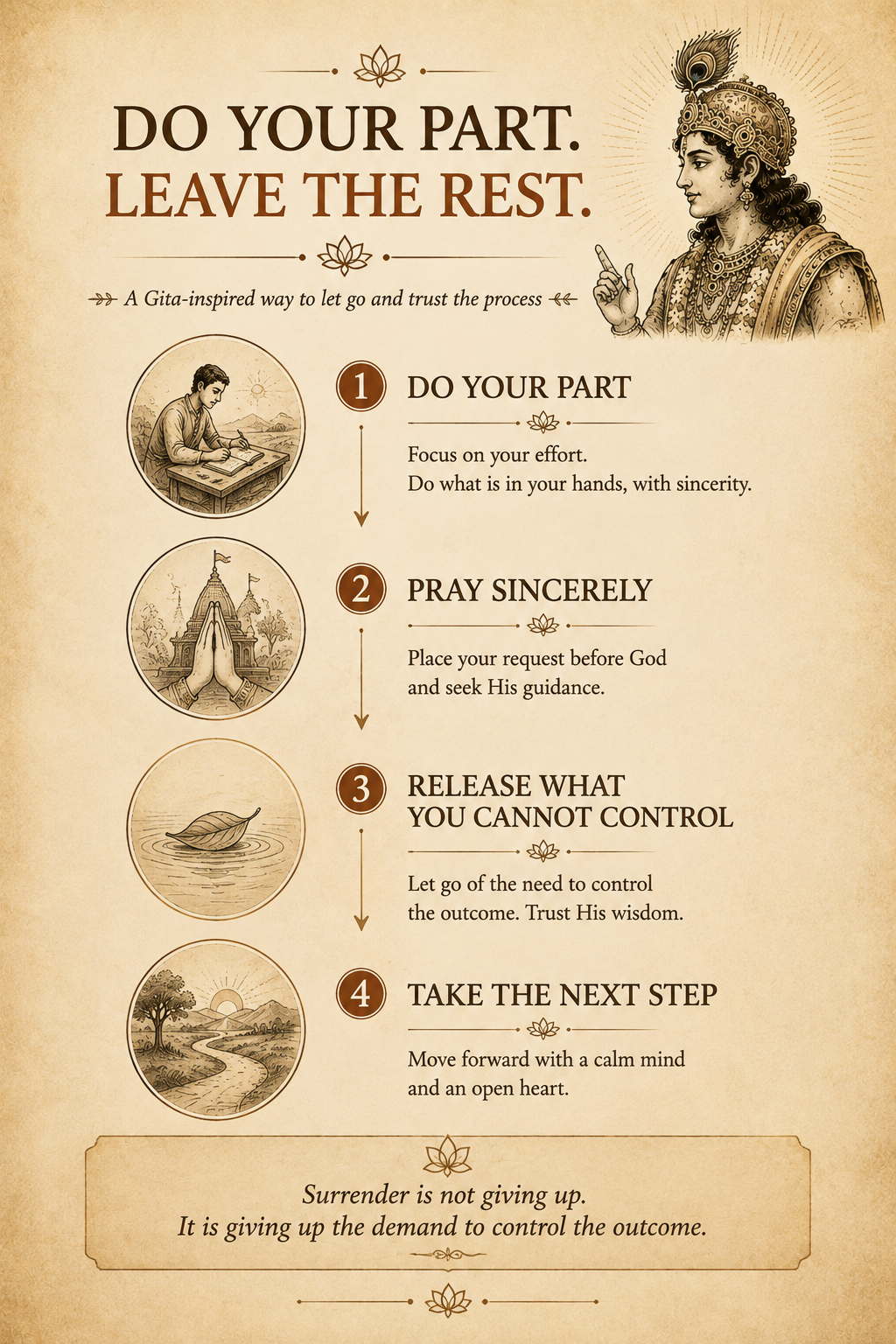
For me, this is perhaps one of the hardest parts of trusting God. I may say that I have left something to Mother, and then find myself thinking about it again a few hours later. But perhaps surrender is not proved by never having the thought again. Perhaps it is learning to hand it back to God each time I realise I have picked it up again.
That is where the Bhagavad Gita on how to stop overthinking and trust the process becomes more than a phrase. You do your part. You leave room for God’s will. And you slowly learn that you do not need to know the entire path before taking the next step.
Bhagavad Gita on Overthinking: Final Thoughts
The Bhagavad Gita on overthinking does not ask you to become a person who never worries, doubts or feels uncertain. It teaches you something more realistic: you can learn how to respond when the mind starts running ahead of you.
Do what is yours to do. Bring the wandering mind back. Practise steadiness. Don’t let a temporary feeling decide your future. And when there is nothing more you can do, give the rest to God.
I am still learning this myself. Some days, surrender feels natural. On other days, I give a worry to God and find myself picking it up again a few hours later. But perhaps that too is part of the practice.
You don’t have to know how everything will unfold. Sometimes, you only need enough trust to take the next step.
Make Space for What the Mind Is Carrying
Some thoughts become clearer when we stop trying to solve them and give ourselves space to write them down. Our 7-day reflective journal offers simple daily prompts to help you slow down, notice what is happening within you, and explore what you may be carrying beneath the surface.
[Explore the 7-Day Reflective Journal →]
Frequently Asked Questions
What does the Bhagavad Gita say about overthinking?
The Bhagavad Gita on overthinking does not use the modern term “overthinking,” but Krishna speaks about the restless mind, attachment to results, difficult emotions, and our tendency to worry about what we cannot control. Its teachings encourage us to bring our attention back to what we can do rather than trying to mentally solve every uncertainty. The aim is not to never have a worrying thought, but to learn how to respond when it comes.
How does the Bhagavad Gita help you stop overthinking?
The Bhagavad Gita on how to stop overthinking teaches us to recognise when the mind has wandered and gently bring it back instead of following every thought. It also reminds us that the mind becomes steadier through practice, not through forcing ourselves to become calm instantly. Over time, this can change the way we respond to recurring worries.
How can I stop overthinking everything?
You don’t have to find an answer to every thought that enters your mind. When you notice yourself going in circles, ask whether there is something you can actually do right now; if there is, take that step, and if there isn’t, allow yourself to leave the question unanswered for the moment. This is one of the practical lessons we can draw from the Bhagavad Gita verses on overthinking.
How can I stop overthinking and trust the process?
The Bhagavad Gita on how to stop overthinking and trust the process points towards doing your part without demanding certainty about the final outcome. You can act sincerely, pray, and still admit that you don’t know what will happen next. Trust grows when you repeatedly stop trying to control what is beyond you and return to the next thing that is actually yours to do.
How to stop negative overthinking?
When negative overthinking starts, first notice whether you are dealing with a real problem or repeatedly imagining possible outcomes. If something needs action, take the action you can take; if nothing can be done at that moment, don’t keep feeding the same thought in the hope that more thinking will create certainty. The Bhagavad Gita on overthinking offers a useful reminder here: a difficult thought does not have to become a prediction about your future.





2 Comments