
Why Do I Feel Spiritually Empty When Nothing Is Wrong?
Nothing is wrong. This is why it makes it more confusing.
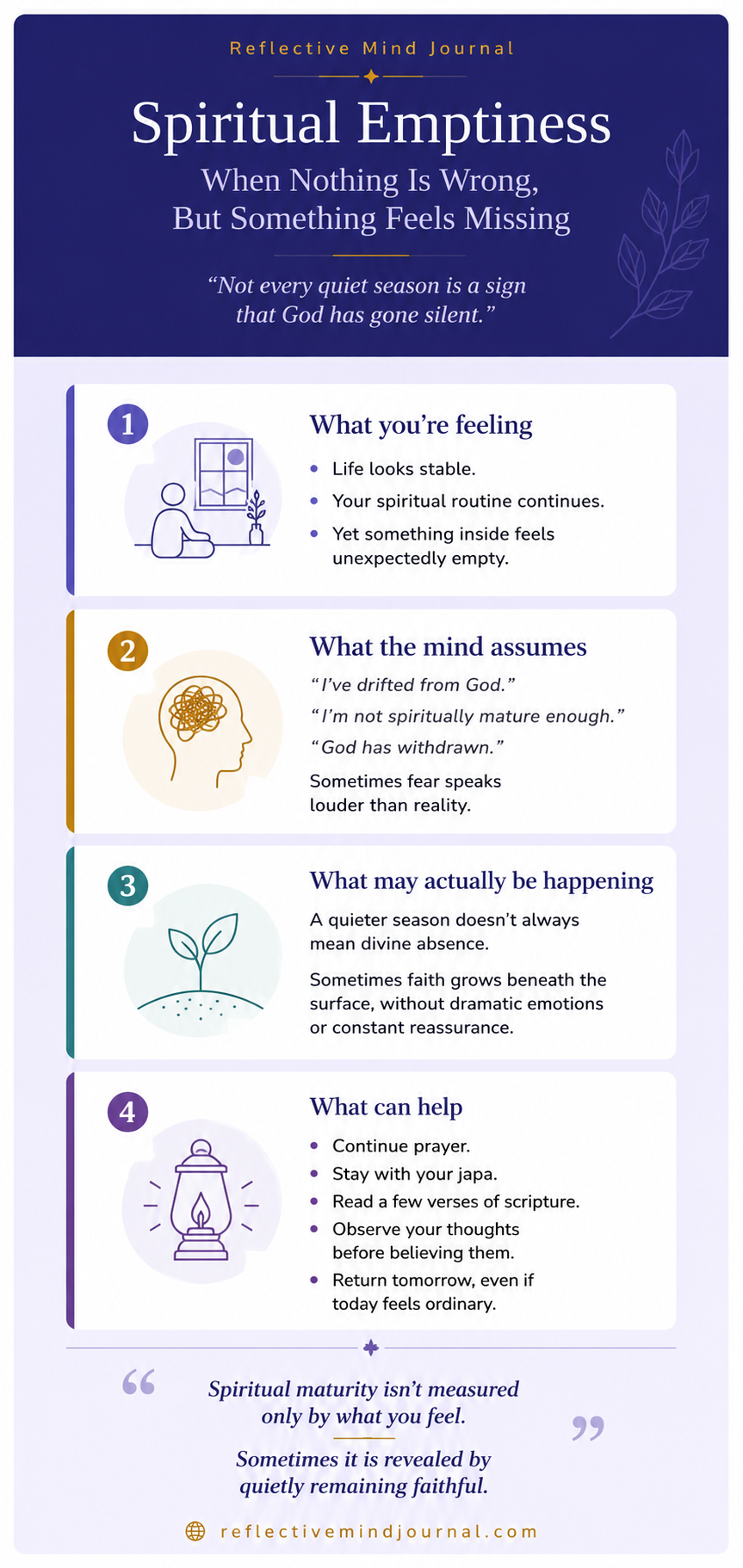
Life looks almost perfect on the outside. Work is moving. You have a daily routine – you wake up pretty early, chant, pray, read, walk, journal maybe, ticking of tasks from the list like a pro.
From the outside, everything seems stable. Maybe even fine.
And yet, somewhere between productivity and prayer, there’s a heaviness in the chest. A quiet restlessness that doesn’t match the outer picture that you probably carry or others know about you.
You call it spiritual emptiness.
I often do too, and want to avoid such a feeling honestly.
However, while writing this piece, I chased my thoughts a little deep and found out a few layers beneath:
For me, it feels like distance.
And the first thought that rises is uncomfortable:
“Maybe God has withdrawn”.
Not dramatically. Not in anger. Just… stepped back.
And almost immediately another layer appears:
Maybe He stepped back because I am not pure enough.
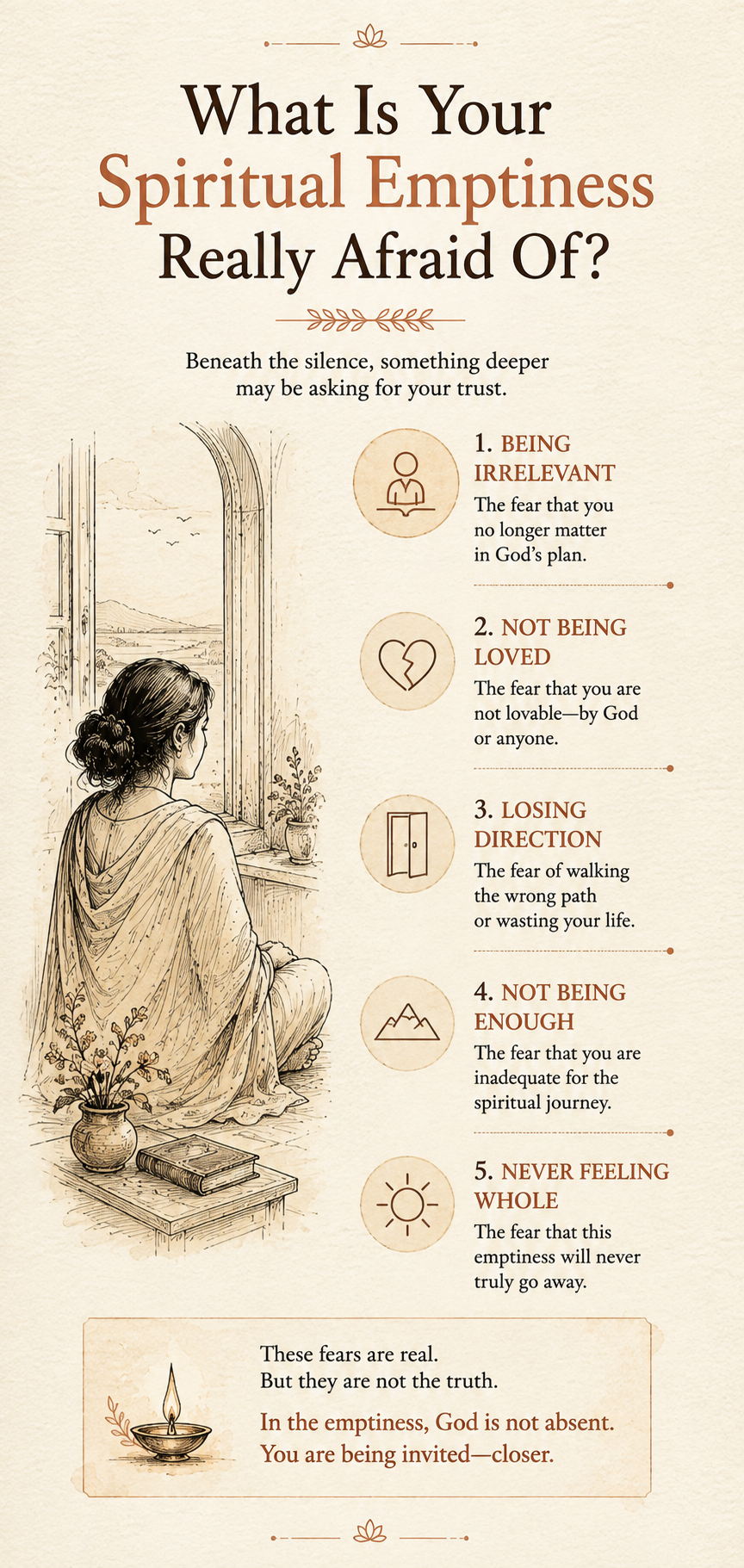
The Fear Behind the Spiritual Emptiness
When you say you feel spiritually empty, you might actually mean you don’t feel close to the Divine?
That you don’t feel surrendered, anchored, steady?
For many people, spiritual emptiness and spiritual loneliness are not exactly the same, but they often overlap in ways that make both experiences difficult to untangle.
There is often a hidden belief underneath – the same one behind why can’t I stop overthinking:
If I were less distracted… less restless… less morally inconsistent… I would feel God more.
The mind whispers “I don’t feel that steady calm saints speak of”.
So when the emotional intensity is absent, the mind concludes:
I must have failed. That belief is heavy.
The Bhagavad Gita describes something different.
In Chapter 6, verses 20-23, Sri Krishna speaks of an inner joy discovered in stillness, a happiness not dependent on outer circumstances.
In Chapter 2, verses 55-57, He describes a mind that becomes steady not because circumstances calm down, but because desires arising from the mind begin to loosen their grip.
Notice the difference.
Steadiness is not the same as intensity. Yet many of us may actually be pursuing emotional surge… and knowingly or unknowingly equate closeness with it.
REFLECTIVE MIND JOURNAL
And when the surge fades, we interpret neutrality as withdrawal.
When Spiritual Emptiness Feels Like Punishment
This looks scary to you, and you associate lack of emotional intensity with the absence of the Divine.
But it might actually be another form of fear:
- Fear that love is conditional. (Just like most human relationships. We have been used to the equation of give and take from childhood.)
- Fear that moral imperfection leads to distance.
- Fear that silence means disapproval.
But what if spiritual maturity is not just emotional intensity? (There may be stages in your sadhana where external outbursts in private or public may happen often, such as flooding of tears, overwhelming joy, and more.) Perhaps it is also the quiet ability to remain steady when nothing dramatic is happening.
What if silence is not punishment, but a quieter form of presence that does not constantly reassure you?
You may still crave intensity. You may still long for signs, confirmations, mystical warmth. That longing itself is deeply human.
But perhaps the emptiness is not proof of withdrawal.
Perhaps it is the discomfort of not being constantly emotionally affirmed.
Perhaps nothing is wrong.
Perhaps nothing has withdrawn.
Perhaps you are standing in a more ordinary phase of spiritual life, one that feels neutral, unspectacular, almost dry, and mistaking it for abandonment.
And that thought unsettles you.
And the mind, unknowingly, finds comfort in a convenient explanation — God has withdrawn. It is easier than sitting with the fear itself.
This is when I realised:
Perhaps I need to understand the difference between divine absence and my own need for constant confirmation.
And that difference is not dramatic.
It is subtle.
Unsettling.
But strangely relieving.
What to Do When You Feel Spiritually Empty but Nothing Is Wrong
If you’re going through a spiritually dry season, you don’t have to solve it immediately. You may simply need to respond differently.
- Keep your spiritual routine simple instead of trying to force a breakthrough. Continue your prayer, japa, or quiet time without expecting every day to feel profound, even if faith feels mechanical. Sometimes, these quiet seasons gently teach us that learning how to surrender to God completely is less about feeling spiritually uplifted every day and more about trusting Him even when His presence feels silent.
- Observe your thoughts before believing them. Notice the story your mind is creating instead of immediately accepting it as the truth. Learning how to stop overthinking and trust God can gradually make those fearful assumptions lose their grip.
- Give yourself permission to experience an ordinary day with God. Not every season of faith will feel emotionally intense, and that doesn’t make it less meaningful. Be honest before God. In Bhagavad Gita 2.7, Arjuna openly admits his confusion and seeks Krishna’s guidance instead of pretending to have unwavering faith.
- Avoid comparing your spiritual life with someone else’s experiences. Your journey doesn’t have to resemble the mystical moments you read about in books or hear in talks.
- Return to your practice tomorrow, even if today feels empty. Consistency often shapes the heart more deeply than chasing extraordinary experiences.
Pro-Tip
Whenever spiritual emptiness feels heavy, ask yourself two gentle questions: Is some measure of inner peace developing? And is selflessness growing?
Sometimes spiritual emptiness isn’t asking you to become a different person. It may simply be inviting you to remain faithful without needing constant reassurance.
If You’d Like a Quiet Space to Reflect on Spiritual Emptiness
If you’re going through a season of spiritual emptiness, you may not need more answers right away. Sometimes, you simply need a quiet space to pause and listen to what is happening within.
I created a 7-day reflective journal on spiritual emptiness for exactly this kind of season — a gentle space to slow down, reflect honestly, and reconnect with what truly matters to you.
[Explore the 7-Day Reflective Journal →]
Frequently Asked Questions
Why do I feel empty when nothing is obviously wrong in my life?
Feeling empty when nothing is obviously wrong can be confusing because your outer life may seem stable while something within still feels unsettled. Sometimes this isn’t a sign that you’ve failed or that your life is lacking. It may simply be a quiet invitation to look beneath your routines, expectations, and constant need for reassurance. Spiritual emptiness can arise even in peaceful seasons, gently asking you to deepen your awareness rather than chase another feeling.
What to do if you feel spiritually empty?
If you feel spiritually empty, resist the urge to judge yourself too quickly. Keep showing up for your spiritual practice, even if it feels ordinary, and allow yourself to be honest about what you’re experiencing. A quiet season doesn’t automatically mean you’ve lost your way. Sometimes it is simply part of a deeper spiritual journey.
Why do I feel spiritually empty?
Feeling spiritually empty doesn’t always mean you’ve lost your faith or that God has become distant. Sometimes spiritual emptiness appears during quieter seasons when your expectations and your experience no longer match. It can become an invitation to look beyond emotional highs and discover a steadier relationship with the Divine.
What does it mean to be spiritually empty?
Being spiritually empty can feel like going through the motions while your heart longs for something deeper. For some people, it reflects emotional exhaustion. For others, it is a season of spiritual growth that feels quieter than expected. Spiritual emptiness does not always point to something being wrong. Sometimes it reveals what your soul is genuinely seeking.
How to deal with spiritual emptiness?
Instead of trying to force spiritual emptiness to disappear, stay faithful to the simple practices that already ground you. Continue with prayer, japa, scripture reading, reflection, or sitting quietly without demanding immediate emotional reassurance. Often, spiritual emptiness becomes easier to understand when you stop treating every silent season as a spiritual failure.
What is the root cause of emptiness?
There isn’t one single root cause of emptiness because every person carries different experiences and expectations. Spiritual emptiness may grow from emotional fatigue, unresolved fears, unrealistic expectations of faith, or the constant need for certainty. Looking honestly at what lies beneath the feeling is often more helpful than trying to escape it.






3 Comments